 ABOUT THE POEM:
 Taj Mahal is not a poem about the monument in India. It uses the Taj Mahal as a metaphor for an unrealized architecture of character—a structure that might have stood not because of romance fulfilled, but because of restraint, clarity, and integrity under emotional uncertainty. The poem begins with an experience that is intentionally ambiguous. Love was neither fully offered nor fully denied. Affection existed, but commitment did not. Emotional closeness appeared possible, yet genuine participation remained absent. This ambiguity becomes the foundation of the poem. Instead of mourning a conventional lost relationship, it examines what happens when a person refuses to exploit uncertainty for temporary gratification. The "Solar" in the poem represents the world of immediate desire, attraction, validation, and transaction. It is the voice that later returns as a ghost, asking whether it would have been better to accept whatever was available—even if it meant lowering one's own standards. The ghost argues that mutual degradation through lust would at least have produced an experience instead of silence. The speaker ultimately rejects that logic. Rather than framing the decision as moral superiority, the poem presents it as structural necessity. Character is treated not as virtue performed for an audience, but as an internal architecture that continues to exist whether praised or ignored. The imagined Taj Mahal therefore never becomes a public monument. Instead, it transforms into "a cathedral of loneliness"—a complete structure without visitors, applause, or recognition. Throughout the poem, architecture replaces psychology. Marble, domes, cathedrals, dust, and empty halls become metaphors for the invisible work of maintaining one's internal structure. The silence described is not emptiness but a closed circuit, suggesting that integrity can exist independently of external validation. The poem also introduces the distinction between the Solar and the Tectonic. The Solar seeks movement through passion, desire, and emotional exchange. The Tectonic represents slow structural endurance—the patient labor of maintaining foundations long after excitement has disappeared. Sweeping empty floors becomes a symbol of preserving one's character even when no congregation ever arrives. The final image, "The dome that never rose still casts its shadow inward," captures the central paradox of the work. An unrealized possibility continues to shape the inner landscape. The monument never existed in the world, yet its absence possesses architectural weight within memory. Polishing unseen marble with the dust of what was refused becomes an act of preserving a structure that only the builder can witness. Ultimately, Taj Mahal is not about regret, nor is it about romance. It is about the cost of refusing to exchange character for temporary relief. The poem argues that some monuments are never built in stone. They are constructed in the invisible continuity of a person's choices, maintained without applause, and completed without spectators. Their beauty lies not in recognition but in the quiet endurance of the structure itself.
Taj Mahal of Character
I was offered ambiguous love from a friend—
the experience taken,
clarity withheld,
participation refused.
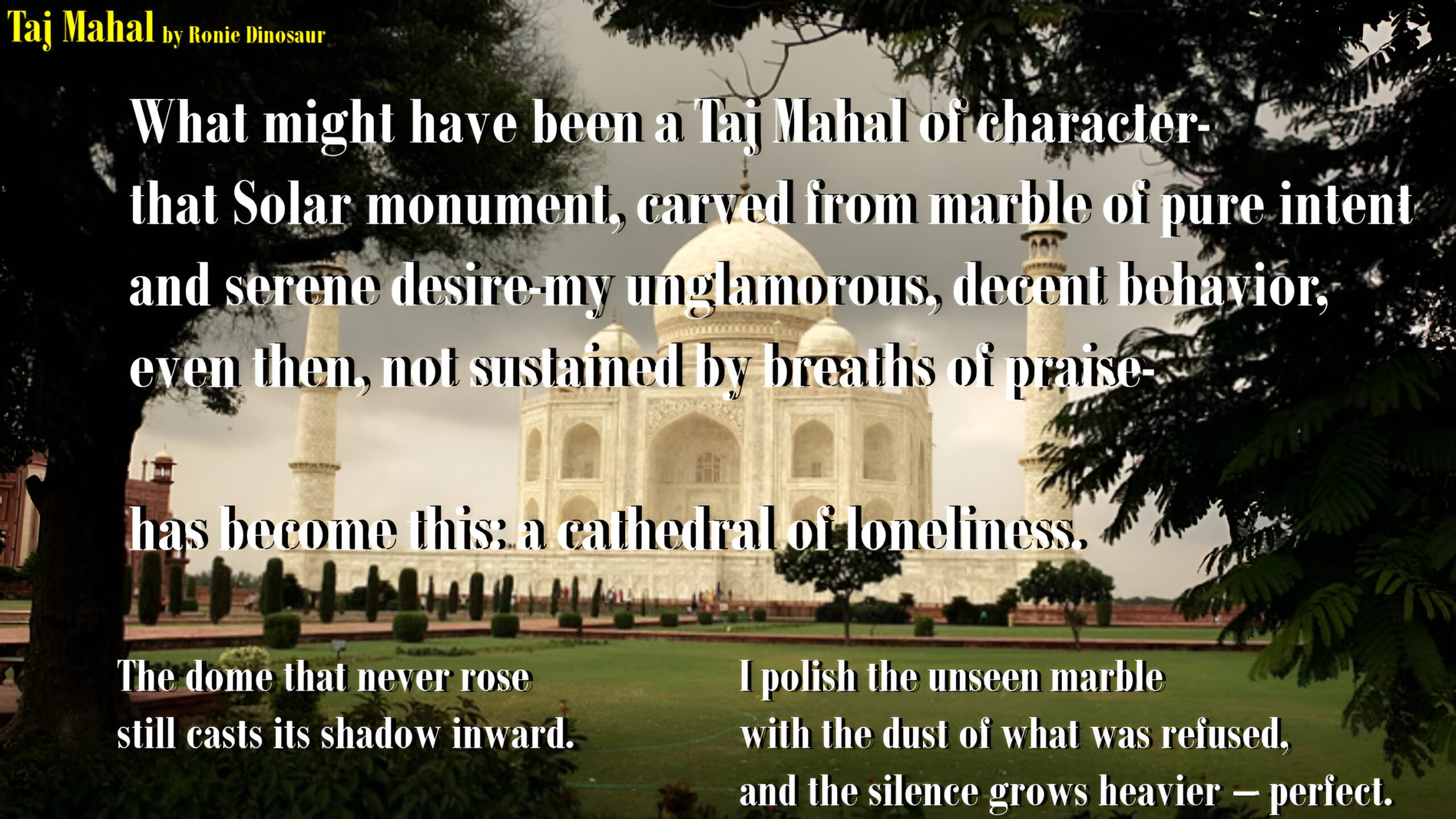
What might have been a Taj Mahal of character—
that Solar monument, carved from marble of pure intent
and serene desire—my unglamorous, decent behavior,
even then, not sustained by breaths of praise—
has become this: a cathedral of loneliness.
Its silence is not absence
but a closed circuit.
Its architecture stands—
unpraised, complete.
Now the old Solar ghost speaks:
You should have taken advantage,
consumed what was offered
when the lost offered themselves willingly.
However awkward, however objectionable—
that mutual degradation through lust
would have been a transaction,
a Solar corruption preferable
to this petty necessity:
to act without the scale of sin or saint,
to move not from desire
but from the bare fact of continuation.
This is the Tectonic grind—
the unglamorous labor
of maintaining a structure
that asked for no congregation
and needs none now,
even as you sweep its empty floors.
The dome that never rose still casts its shadow inward.
Its absence has become its architecture.
I polish the unseen marble with the dust of what was refused,
and the silence grows heavier— perfect.
In the cathedral I built, each almost
is a stained-glass pane— light pours through,
colours my loneliness beautiful,
and leaves me untouched.