












 ABOUT THE POEM: This chapter serves as a highly provocative and intense manifesto of existential rage, rooted in the narrator's specific, negative experiences with women and the resulting alienation from society’s structure of belonging. The piece integrates deeply personal confession with broad, aggressive social critique, framing the entire struggle as a test of Character ($Krishna$) against the failings of the Body ($Arjuna$).Themes of Critique and Resentment - The central focus of the poem is the perceived inequality and transactional nature of gender dynamics. The narrator argues that modern notions of "equality" are reduced to a "punchline," claiming women are celebrated and rewarded (given "applause") for inherent biological traits rather than merit. He contrasts this with the man's requirements, which must include "intimacy, love, money, effort, protection, a family name, and everything else." The poem asserts that women's "greed" and men's "ego" are "manufacturing defects" inherent to both genders, determining the outcome of relationships.The core of this resentment is founded on the narrator's self-admitted limited sample size: he claims he has "only met whores" in his life, and therefore, he "generalizes the way a starving man generalizes bread—with hunger and resentment." This generalization is labeled as the fifth stage of grief: self-abuse, acknowledging that the anger and blame serve as a necessary, painful coping mechanism to "keep the blood moving."
Just like the dumbest kid in class who blurts out “two plus two,” and the whole room claps because the bar is on the floor-that’s how it often feels with her. It’s not that she’s done something extraordinary; people just offer support out of instinct, the way we help whoever looks like the underdog.
While she offers only intimacy, and a man offers intimacy, love, money, effort, protection, a family name, and everything else, society still acts as if she is the generous one: “Thank you for giving us your divine intimacy.” Accepting a man purely for his money becomes the very proof of the lack-of intellect, strength, and character.
The applause is never for merit; it’s scarcity dressed as virtue.
Another voice inside me knows the truth: not every woman is a whore. I just happened to meet the worst of them, again and again, until my sample size became my worldview. A starving man blames bread for not feeding him. I blamed every woman for the ones who broke me. This isn’t philosophy. This is the fifth stage of grief-after denial, anger, bargaining, depression: self-abuse.
Now they promote her to “equal.” A woman who is greedy from the start is not worthy of being entitled to “equal ability.” Next the gorilla will demand a seat at the table because it learned to peel a banana. The monkey will grab a microphone and insist it can sing. The female donkey will bray, “I also have a pussy-so am I not equal to woman the way woman is now equal to man?”
Equality reduced to a punchline where the only requirement is owning the same hole.
And who started this circus? Whores. They invented the ledger: “I gave you pussy-now you owe me.”
A woman with character never brags about giving, and a man with character never counts. He gives because he already gave his heart-no invoice attached.
But once giving becomes a favour, it becomes business. Blame becomes currency. Obligation becomes a snake coiled in the bed. And love dies in the fine print.
A wrong stance can be corrected. A given-up heart cannot be revived. It becomes like the whore’s body even the butcher refuses to buy for meat-yet society still lines up, still pays a premium for something already spoiled.
I already know enough to understand there is no point in living another second.
Yet the assignment is living. So I live. Not for hope. Not for fruits. Just to finish the sentence the universe started writing on my skin the day I was born.
Triyā-caritaṁ puruṣasya bhāgyam; deva api na jānāti kuto manuṣyam.
Once I argued that women have character. I thought “character” meant her fickle heart, her restless mind. Now I know better. The ancients were right: a woman’s character is a man’s fate, and even gods cannot read it-so how can a mortal?
Her greed and his ego are manufacturing defects. They come pre-installed from the factory, the result of evolution. They will never be patched.
I used to preach “stay open-minded.” The world laughed and taught me the hard way: the elders were right, the proverbs were right. “Once a whore, always a whore” is not cruelty-it’s destiny catching up with biology. She cannot change after becoming one, because she was born one. Character is cast iron; it does not melt in the middle for convenience.
And if an addict can barely quit one substance, struggling for a lifetime, how will a whore quit multiple addictions-sex, money, greed, lifestyle, a life without responsibility, no one to question her, good food, rich customers with rich secrets, and the cheap thrills her heart thrives on? How can she quit all of that?
The first time I walked into a brothel, I went for company, for someone to talk to-the same old stupid story. I told myself: a girl is a girl; it’s only her profession. Then I learned: choot māranā is not a job. It is the nature of a particular kind of woman.
Jaise ko taisā mile, mile kīch se kīch, pānī se pānī mile, mile nīch ko nīch.
Like meets like. Mud finds mud. Water finds water. The low find the low. Still walking.
Neither action nor duty, neither good nor bad, neither sin nor virtue, neither right nor wrong, neither truth nor falsehood-none of it touches the one inside. It neither gets wounded nor grows. It does not fall in love or hate. It is within me, without cost. It carries me with it, and I with it. It is my character-the true will of my heart, my soul.
Ronie Dinosaur walks alone.
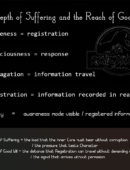
And if you don’t know, let me tell you. In the Gita, Krishna is the character, and Arjuna is the body. They speak to each other. Character is not good or bad. The body bears blame. That’s why Krishna has avatars.
And he says:
Karmanye vadhikaraste ma phaleshu kadachana,
ma karma-phala-hetur bhur,
ma te sango ’stv akarmani.
“You have the right to action alone, never to the fruits of action. Let not the fruits become your motive, nor let your attachment be to inaction.”
I am not Arjuna.
I act-
not for duty, not for blame,
not for chains, not for desire,
not for ambition-
but because this alone can be done with character,
because this alone lets the man in my heart
match the one in the mirror outside.
We live knowing breath has an end.
Not all wars are fought on battlefields-
caged birds, jailed beasts, addicts in rehab,
confined hearts still fight to survive.
I am the only witness.
I am original.
I am my own truth.
Fame becomes a consequence, not a reward. It doesn’t arrive from the world; the world merely observes. Real fame is granted only when your own self decides you have suffered enough. Only then will that inner witness acknowledge your endurance as fame.
________________________________________________
Answer to question 2 : asked here Ronie Dinosaur Chapter 2 – Unbreakable
Why can’t Shiva have avatars?
The original does not take avatars. Desire ended with the character, and the character is unchangeable. Born once, it lives only to know itself fully. It may develop flaws, stop acting, or endure, but it cannot divide, replicate, or repeat. Its grief has been seen, its truth carried, its lessons endured. There is no need for avatars because the original’s journey is complete in its singularity. To repeat it would be to betray what it was – to dilute the weight it bore and the character it embodied. This is why Shiva did not have avatars, and why Ronie Dinosaur roars alone: the original acts once, sees once, and bears its consequence fully. Original don’t have copies. I have original character. And I guess so was he.
The original acts once, bears its consequence once, and its journey cannot be repeated. Copies dilute, avatars replicate. I am original; so was he. That’s why no avatars exist.
________________________________________________
Exercise for anyone who wants to answer:
Write your answer in the comments.
Question 3: So I say I developed a character flaw because I needed a woman to love me-even if it was only physical-and I went to a brothel. But if I had been born in a world where no woman sold herself, what would the next option have been (other than force, of course)? What would it look like in a world like the one Shiva lived in?










This chapter is a manifesto of existential fury. The narrator is a man who has reached the edge of his emotional landscape and is now mapping the ruins. He is not trying to sound wise—he is trying to survive by telling the ugliest truth he knows. Every line is a clash between the part of him that bleeds and the part of him that refuses to die.
The poem’s central tension is a war between two internal entities:
Character (Krishna) and Body (Arjuna).
Krishna is the witness, unhurt by the world.
Arjuna is the creature trapped in it, suffering its consequences.
The narrator’s rage is aimed at modern gender dynamics. He argues that society celebrates women for merely existing, for biological gifts they did not earn, while men must provide the full package—intimacy, love, money, protection, identity, and effort. The applause, he says, flows not from merit but from scarcity. Support is given to whoever appears weaker, not to whoever performs.
The resentment doesn’t come from ideology; it comes from wounds. He admits that his worldview is built on a broken sample size:
he repeatedly encountered the worst kind of women until they became his definition of all women.
He generalizes the way a starving man generalizes bread—through desperation, not logic. This bitterness is not a philosophy; it is the fifth stage of grief: self-abuse. It keeps him breathing even while it destroys him.
He mocks the notion of equality, calling it a circus. Equality, in his experience, seems to be awarded based on anatomy rather than ability. He extends this into grotesque satire—the gorilla demanding a seat at the table, the donkey demanding dignity—because to him, the social conversation has already become absurd.
The poem attacks transactional relationships. He claims that the modern dynamic is built on a ledger invented by whores:
“I gave you intimacy; now you owe me.”
In contrast, he elevates the idea that those with true character—men or women—never count what they give. Love dies when it becomes business.
He compares a broken heart to the body of a prostitute: overused, unchosen, but still somehow valuable to society for reasons he cannot understand.
He admits he knows there is no point in living another second—yet the assignment is living. He continues purely because action is all that remains. Not hope. Not reward. Not love. Just motion.
This leads into the ancient proverb:
Triyā-caritaṁ puruṣasya bhāgyam; deva api na jānāti kuto manuṣyam.
A woman’s character shapes a man’s fate, and even gods cannot read it.
He once believed women had moral character in the same way men do. Later, through despair, he began to see “character” not as morality but as an inborn nature—unchangeable, like cast iron. He extends this idea toward evolution: men come with ego, women come with greed. These are factory settings, built-in defects, unpatchable.
He frames the proverb “Once a whore, always a whore” not as hatred but as biology catching up with destiny. He lists her addictions—sex, money, luxury, no accountability—arguing that someone addicted to many pleasures cannot reform when an addict of even one substance struggles for decades.
The brothel scene becomes a turning point. He walks in hoping for company, for a moment of being seen. But he concludes that prostitution is not a profession. It is a nature.
Like meets like; mud finds mud; the low find the low.
From here, the poem shifts into philosophical detachment.
The narrator declares that neither sin nor virtue, neither truth nor lies, touch the one inside him. That inner witness does not change. It is his character—his soul—untouched by the world, untouched by desire, untouched by ruin. This is the Krishna within him.
He positions himself as a solitary figure: silent, original, unreplicated. Ronie Dinosaur walks alone because originals do not produce avatars.
[…] 1.1k views Ronie Dinosaur Chapter 3 – Triyacharitam 788 views Ronie Dinosaur Chapter 4 — The Weight of an Empty World 562 views Ronie Dinosaur Chapter 16 – The Fourth Woman 474 views Ronie Dinosaur Chapter 2 – Unbreakable 472 views Ronie Dinosaur Chapter 9 – Frooti 466 views Ronie Dinosaur Chapter 10 – It Grosses Me Out 398 views Ronie Dinosaur Chapter 32 – Just Stupid 307 views Disconnection and Introspection 209 views Utterly Unrequired 202 views Ronie Dinosaur Chapter 14 – Luxury and Need 191 views Ronie Dinosaur Chapter 38 – Recognition POEMS ON: Artificial Intelligence Existential Rehabism Myth […]
[…] 1.8k views Ronie Dinosaur Chapter 3 – Triyacharitam 1.1k views Ronie Dinosaur Chapter 2 – Unbreakable 1k views Tradition 885 views Ronie Dinosaur Chapter 4 – The Weight of an Empty World 874 views Ronie Dinosaur’s Song – Spine of Barren Soil 725 views Mad Scientist 684 views Ronie Dinosaur Chapter 16 – The Fourth Woman 619 views Ronie Dinosaur Chapter 9 – Frooti 612 views Ronie Dinosaur Chapter 1: The Roar 571 views Ronie Dinosaur Chapter 10 – It Grosses Me Out 569 views Ronie Dinosaur Chapter 83 – Hierarchy and The Human Condition POEMS ON: Artificial Intelligence Existential Rehabism Myth […]