










Hydrogen and oxygen atoms coming together to form nano sized bubbles of water
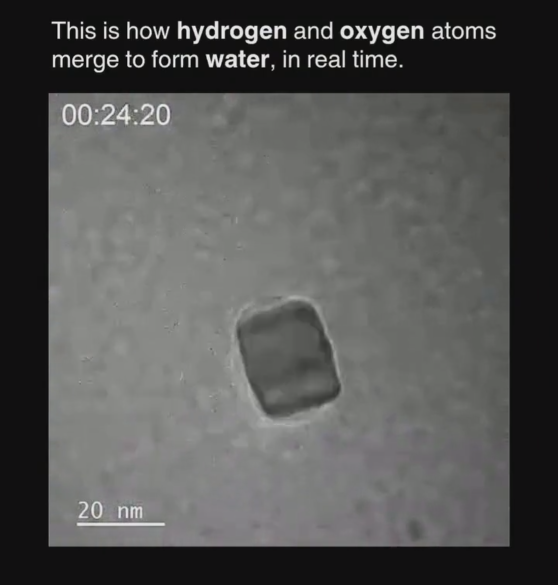
The formation of water at the molecular scale has just been captured in real time. For the first time, researchers observed hydrogen and oxygen atoms coming together to form nano sized bubbles of water directly on the surface of palladium.
This discovery comes from a team at Northwestern University, where scientists used a new ultrathin glassy membrane to visualize gas molecules inside honeycomb shaped nanoreactors. By placing these nanoreactors inside a high vacuum transmission electron microscope, they were able to watch hydrogen atoms enter palladium, expand its lattice, and then combine with oxygen to create what may be the smallest water bubbles ever recorded.
The work builds on decades of research showing that palladium catalyzes water formation, but this is the first time the exact pathway has been seen at the atomic level. Using this new imaging method, the researchers found that adding hydrogen first and then oxygen significantly accelerates the process. Palladium absorbs the hydrogen, expands, and then contracts again as the hydrogen exits to react with oxygen.
This reaction occurs without fire, high heat, or extreme pressures making it a potential solution for generating water in arid environments or even during space missions. Imagine pre loading palladium with hydrogen before a long spaceflight. Astronauts would only need to add oxygen to generate water for drinking or growing plants, and the palladium could be reused repeatedly. Read more from here...