










Cell Division Explained
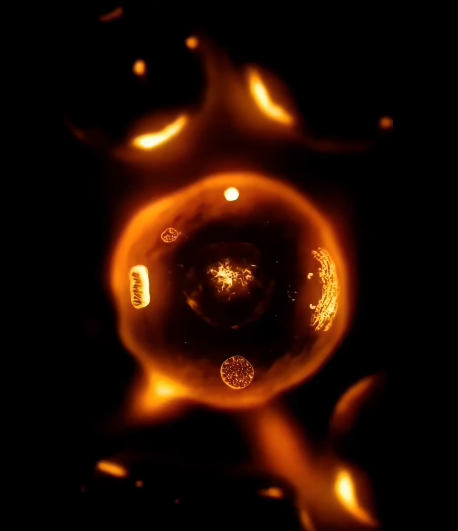
During cell division, organelles are distributed to daughter cells through a process that involves duplication, segregation, and rearrangement. While the nucleus is divided by mitosis, other organelles are partitioned during cytokinesis, the division of the cytoplasm. Read more from here...
Housefly

Should I lie and say something else?
What have I actually observed in this world?
I witnessed every woman I met choose someone-anyone-but never me.
Should I pretend they rejected me because there’s some fundamental flaw in me?
If my heart is not able to feel love at all,
or the thing in my heart is not love at all? Read more from here...
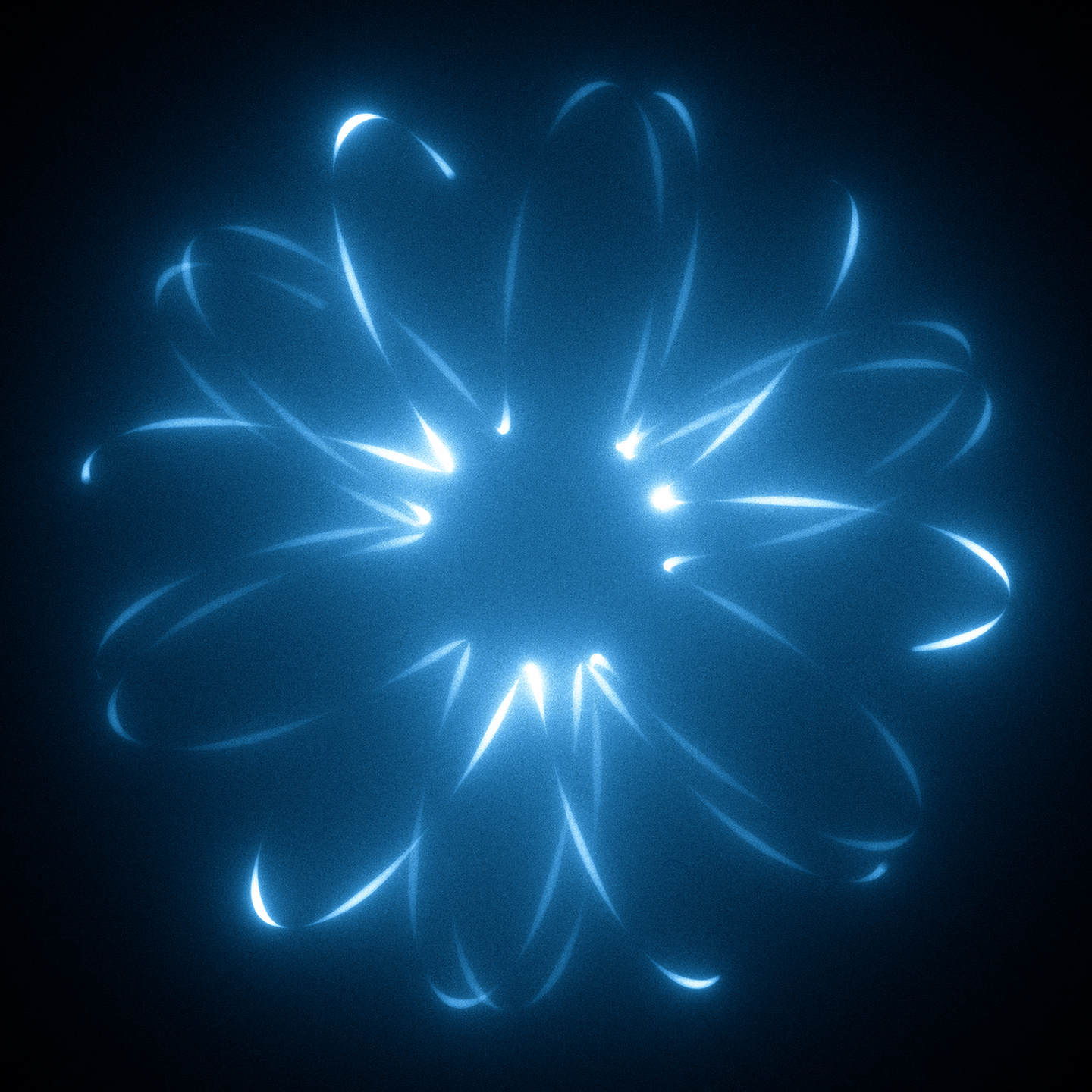
The Zinc Spark is a remarkable Phenomenon that occurs at the moment of Human Fertilization
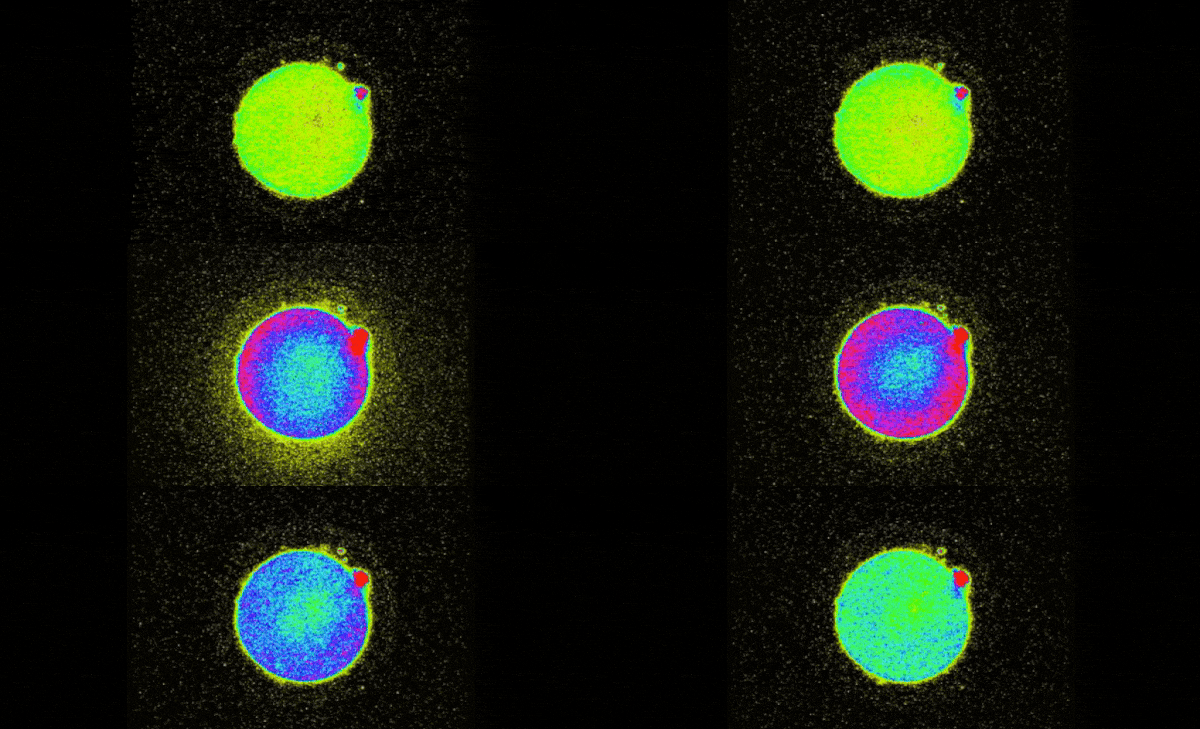
The zinc spark is a remarkable phenomenon that occurs at the moment of human fertilization. When a sperm successfully enters an egg, the egg releases billions of zinc ions in a sudden burst. These ions bind with small molecules, creating a flash of light visible under a microscope. This luminous event marks the precise instant that a new life begins to form.
Scientists first observed the zinc spark in mouse eggs and later confirmed its presence in human eggs. The discovery revealed just how critical zinc is during the early stages of development. The intensity of the spark even appears to indicate the health and viability of the egg, offering potential applications for fertility treatments and embryo selection during in vitro fertilization.
This natural burst of light is not just visually stunning but also scientifically important. It shows that the egg is responding to fertilization and beginning the complex process of cell division and growth. The zinc spark is a literal flash of life, providing researchers a rare and beautiful window into the very first moments of human development. Read more from here...
Hydrogen and oxygen atoms coming together to form nano sized bubbles of water
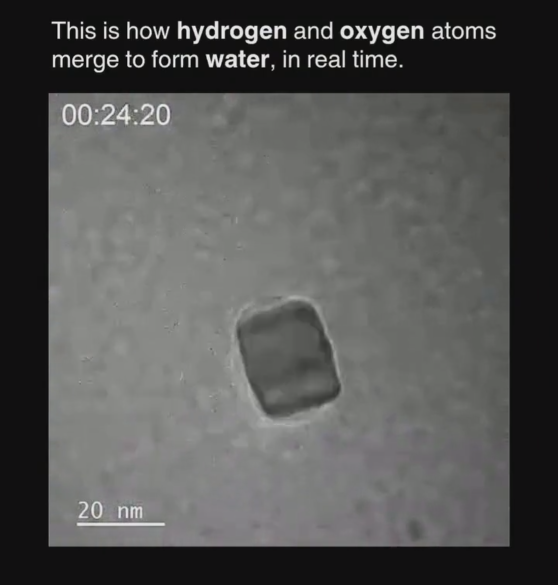
The formation of water at the molecular scale has just been captured in real time. For the first time, researchers observed hydrogen and oxygen atoms coming together to form nano sized bubbles of water directly on the surface of palladium.
This discovery comes from a team at Northwestern University, where scientists used a new ultrathin glassy membrane to visualize gas molecules inside honeycomb shaped nanoreactors. By placing these nanoreactors inside a high vacuum transmission electron microscope, they were able to watch hydrogen atoms enter palladium, expand its lattice, and then combine with oxygen to create what may be the smallest water bubbles ever recorded.
The work builds on decades of research showing that palladium catalyzes water formation, but this is the first time the exact pathway has been seen at the atomic level. Using this new imaging method, the researchers found that adding hydrogen first and then oxygen significantly accelerates the process. Palladium absorbs the hydrogen, expands, and then contracts again as the hydrogen exits to react with oxygen.
This reaction occurs without fire, high heat, or extreme pressures making it a potential solution for generating water in arid environments or even during space missions. Imagine pre loading palladium with hydrogen before a long spaceflight. Astronauts would only need to add oxygen to generate water for drinking or growing plants, and the palladium could be reused repeatedly. Read more from here...
Ladybugs hide a powerful secret: their wings 🐞
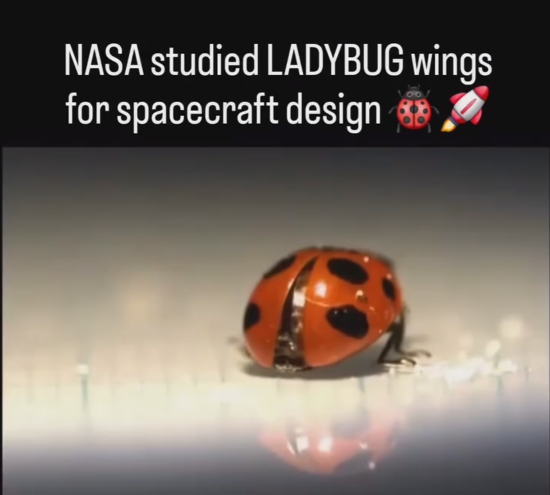
Ladybugs hide a powerful secret: their wings. 🐞
When they fly, huge, flexible wings unfold from under tiny shells - and then fold back with flawless precision. This natural design is strong, compact, and efficient.
NASA engineers studied this exact mechanism to develop foldable spacecraft parts, like solar panels and antennas. Just like a ladybug’s wings fit under its shell, satellites must fit inside rockets - and then unfold perfectly in space.
Nature solved the problem millions of years ago. NASA just copied it. Read more from here...
Inside every Proton lies a restless ocean of quarks and gluons
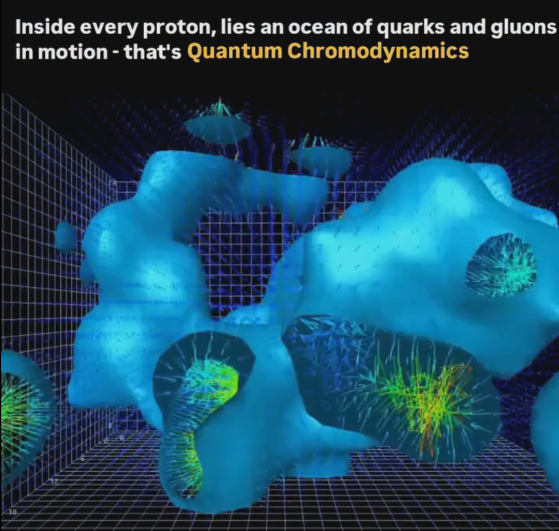
Inside every proton lies a restless ocean of quarks and gluons, the fundamental entities governed by Quantum Chromodynamics (QCD) - the theory describing the strong nuclear force, the most powerful interaction in nature. Unlike electrons orbiting nuclei, quarks are never isolated; they're confined by gluons, the force carriers that constantly exchange "color charge." This continuous interaction generates almost all the proton's mass - not from the quarks themselves, but from the energy of their motion and the gluon field. QCD reveals that matter isn't static - it's a dynamic sea of quantum energy, held together by the strongest force in the universe. Read more from here...
What Learning Actually Looks Like – Neuroplasticity
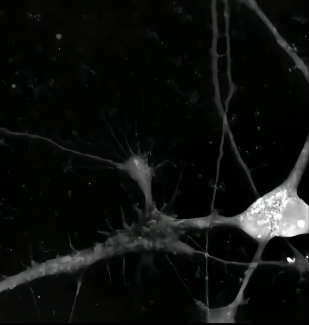
By extending an axon to meet another neuron's dendrites or cell body. At the synapse, the first neuron releases neurotransmitters, which are chemical messengers that travel across a small gap and bind to the second neuron, causing it to either fire its own signal or remain quiet. This entire process is a fundamental mechanism of how neurons communicate, and it can be strengthened or altered through activities like learning and repetition, a phenomenon known as neuroplasticity. Read more from here...
Photosynthesis in Real Time
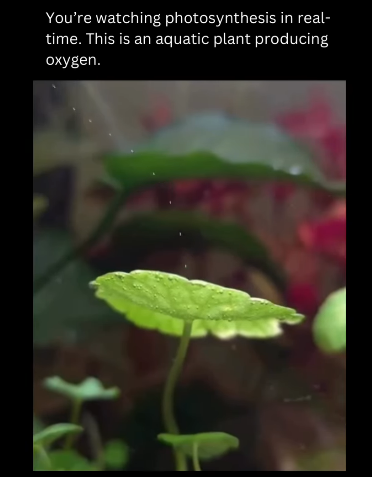
In certain aquatic plants like Elodea and Cabomba, you can actually see photosynthesis in action.
Place one of these plants in water under bright light, and something remarkable happens. Tiny oxygen bubbles begin to form on the leaves and stems, slowly rising to the surface in delicate streams. What you are watching is the plant converting sunlight into chemical energy, releasing oxygen as a natural byproduct.
It is one of the rare moments where a biological process becomes visible, offering a quiet, beautiful glimpse into the power of photosynthesis. Read more from here...
A Photon’s lifespan is zero – Light exists Outside of Time
According to the principles of special relativity, as an object's speed increases and approaches the speed of light (c), time dilation occurs, meaning time slows down for that object relative to a stationary observer.
For a hypothetical object traveling exactly at the speed of light, time would effectively stop. From the perspective of a photon, which is massless and always travels at the speed of light in a vacuum, the distance between any two points is zero due to length contraction, and the time taken to travel that distance is also zero due to time dilation. Its entire existence-from emission to absorption-is a single, instantaneous event, illustrating the profound and counter-intuitive nature of the universe as described by Einstein's theories.
For a photon, time stands still. Traveling at the speed of light, it experiences no passage of time, no matter the distance it covers. From a photon’s perspective, emission and absorption are instantaneous events, revealing the strange and fascinating nature of relativity. Read more from here...
Phoenix A – Largest Supermassive Black Hole discovered near Earth
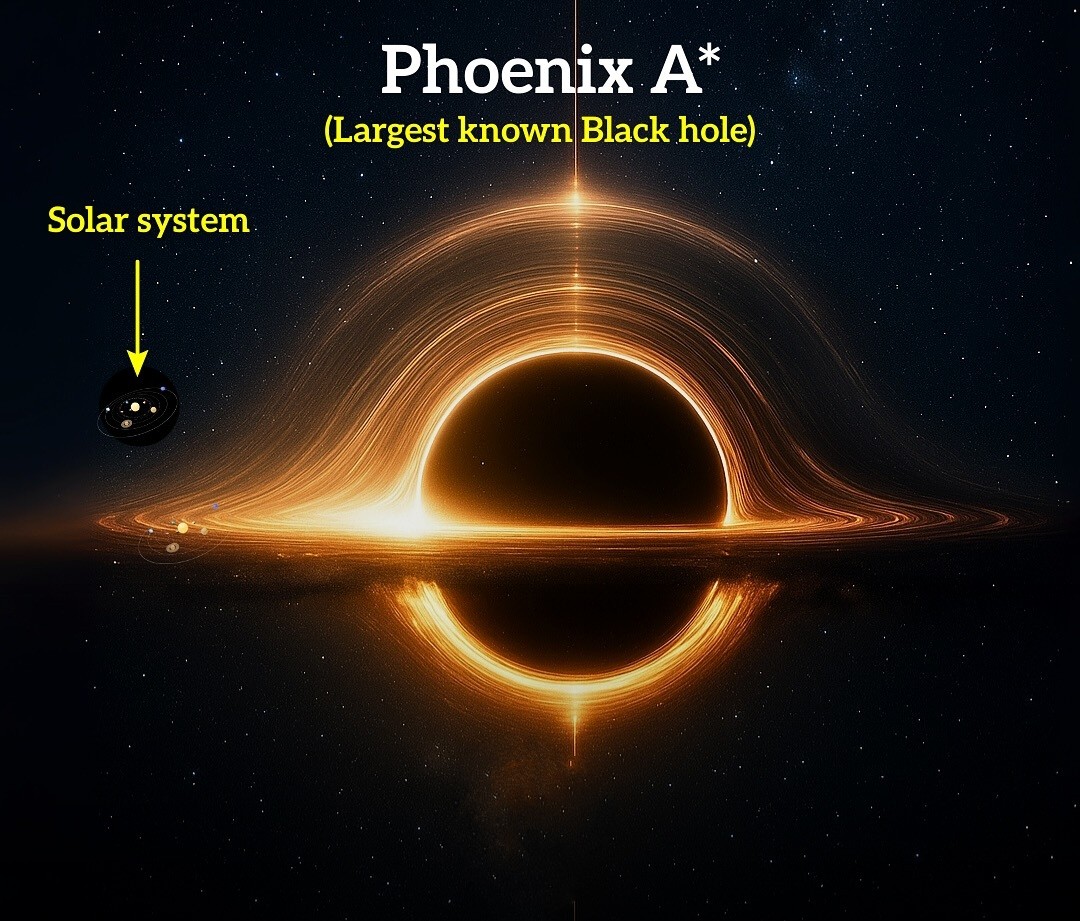
This ultra-massive black hole is located in the Phoenix Cluster about 5.8 billion light-years from Earth.
At roughly 100 billion solar masses, Phoenix A is more massive than entire galaxies. That’s unimaginably monstrous for one single object.
Phoenix A has an estimated diameter of 590 billion kilometers. If it were placed at the center of our solar system it would extend 50 times farther than Pluto.
Astonishing. Read more from here...