ABOUT THE POEM: Noori Dinosaurni is a voice positioned under pressure—observed, interpreted, and reduced through the gaze of others—yet not entirely erased by it. The central image, “their eyes have a face,” reverses the direction of perception. It is no longer the speaker who is seen; it is the act of seeing itself that becomes intrusive, shaped, and almost embodied. This inversion establishes the environment of the poem: a space where identity is not self-defined but continuously overwritten. The speaker does not resist through confrontation. Instead, she adapts, folds inward, and allows the interaction to proceed. This is not compliance in the moral sense, but a functional response to a system that has already decided her role. The line “they don’t ask me what I need—they only see what they can feed” captures this asymmetry precisely. Need is irrelevant; projection governs the exchange. However, the poem avoids collapsing into victimhood. A key structural refusal appears in the line: “I never name my weakness as helplessness.” Weakness is acknowledged, but it is not equated with absence of agency. This distinction prevents the voice from being defined solely by what is done to it. The bridge introduces a moment of potential surrender—“just enough to get paid”—but interrupts it immediately with an internal resistance: “Something inside me refused their will.” This refusal is not dramatic or external. It is quiet, internal, and non-negotiable. It does not change the situation, but it preserves a boundary that is not visible to others. The recurring line, “Noori Dinosaurni is breathing,” functions as a structural anchor. Breathing is not a choice or a performance; it is a condition of being alive. In contrast to more deliberate forms of continuation, this suggests persistence without decision—existence that continues regardless of circumstance. It sits alongside the erosion described in the chorus: “what they leave when they’re done with me.” The poem holds both states simultaneously—diminishment and continuation. The outro completes the framework by redefining love. It is not measured by acceptance, safety, or response. Those external metrics are explicitly rejected. Instead, love is limited only by internal capacity: “as far as my own capacity reaches.” This does not claim purity or infinity. It introduces a boundary, but one that belongs entirely to the speaker. The result is a piece that does not resolve its tension. The speaker is partially erased—“Mine disappears”—yet something remains operational. The capacity to give, to feel, to continue, is not dependent on recognition or return. It persists within its own limits. This is not a statement of hope or redemption. It is a description of a system that continues to function under pressure, without requiring the world to change.
Noori Dinosaurni
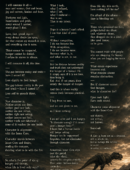
(Verse 1) I face their eyes, their eyes have a face. How do I fold into myself to cover, to hide?
(Chorus) It’s not about a girl— no. It’s about what they leave when they’re done with me. It’s about what I am not in this world.
Noori Dinosaurni is breathing. Noori Dinosaurni is breathing.
(Verse 2) I am afraid their intent has a price, and I come to melt, to drown, to show myself there is a life.
But I never name my weakness as helplessness.
I hear their thoughts before they speak, feel their hunger when they breathe.
They don’t ask me what I need— they only see what they can feed.
So I let it happen, I play it through— not because I want it, but because I have chosen to.
[Bridge] For a moment, I almost stayed— just enough to get paid.
My body moved. My mind went still.
Something inside me refused their will.
[Chorus – Reprise] It’s not about a girl— no. It’s about what they leave when they’re done with me.
Every look, every lie— takes a piece I can’t deny.
I’m still here, but something’s gone— they move along, I carry on.
Noori Dinosaurni is breathing. Noori Dinosaurni is breathing.
[Outro] Their eyes have a face. Mine disappears.
Still, I want to give love, as far as mine can go— not as far as they will accept, or as far as safety allows, but as far as my own capacity reaches.
When you login first time using a Social Login button, we collect your account public profile information shared by Social Login provider, based on your privacy settings. We also get your email address to automatically create an account for you in our website. Once your account is created, you'll be logged-in to this account.
DisagreeAgree
Connect with
I allow to create an account
When you login first time using a Social Login button, we collect your account public profile information shared by Social Login provider, based on your privacy settings. We also get your email address to automatically create an account for you in our website. Once your account is created, you'll be logged-in to this account.










 ABOUT THE POEM: Noori Dinosaurni is a voice positioned under pressure—observed, interpreted, and reduced through the gaze of others—yet not entirely erased by it. The central image, “their eyes have a face,” reverses the direction of perception. It is no longer the speaker who is seen; it is the act of seeing itself that becomes intrusive, shaped, and almost embodied. This inversion establishes the environment of the poem: a space where identity is not self-defined but continuously overwritten. The speaker does not resist through confrontation. Instead, she adapts, folds inward, and allows the interaction to proceed. This is not compliance in the moral sense, but a functional response to a system that has already decided her role. The line “they don’t ask me what I need—they only see what they can feed” captures this asymmetry precisely. Need is irrelevant; projection governs the exchange. However, the poem avoids collapsing into victimhood. A key structural refusal appears in the line: “I never name my weakness as helplessness.” Weakness is acknowledged, but it is not equated with absence of agency. This distinction prevents the voice from being defined solely by what is done to it. The bridge introduces a moment of potential surrender—“just enough to get paid”—but interrupts it immediately with an internal resistance: “Something inside me refused their will.” This refusal is not dramatic or external. It is quiet, internal, and non-negotiable. It does not change the situation, but it preserves a boundary that is not visible to others. The recurring line, “Noori Dinosaurni is breathing,” functions as a structural anchor. Breathing is not a choice or a performance; it is a condition of being alive. In contrast to more deliberate forms of continuation, this suggests persistence without decision—existence that continues regardless of circumstance. It sits alongside the erosion described in the chorus: “what they leave when they’re done with me.” The poem holds both states simultaneously—diminishment and continuation. The outro completes the framework by redefining love. It is not measured by acceptance, safety, or response. Those external metrics are explicitly rejected. Instead, love is limited only by internal capacity: “as far as my own capacity reaches.” This does not claim purity or infinity. It introduces a boundary, but one that belongs entirely to the speaker. The result is a piece that does not resolve its tension. The speaker is partially erased—“Mine disappears”—yet something remains operational. The capacity to give, to feel, to continue, is not dependent on recognition or return. It persists within its own limits. This is not a statement of hope or redemption. It is a description of a system that continues to function under pressure, without requiring the world to change.