 ABOUT THE POEM:
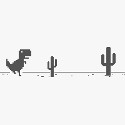
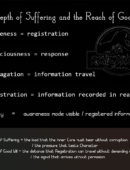
 Chapter 87, What Is Peace?, occupies a transitional space in the Ronie Dinosaur sequence. It does not seek resolution, redemption, or rebellion. Instead, it documents a state of awareness reached after prolonged observation—where explanations feel dishonest and silence feels more truthful than answers. The chapter unfolds as a chain of thoughts, each arising naturally from the previous one, without attempting to form a system or doctrine. The opening establishes the central fracture: the mismatch between existential freedom and social accountability. Existentialism assigns responsibility on the basis of freedom, while society assigns guilt on the basis of obligation. Both proceed as if consent were irrelevant. Birth is treated as a premise rather than a question, and morality begins only after that premise is silently enforced. This omission—consent never being asked—is presented not as a grievance but as a structural flaw. From it arises what the chapter names “quiet cruelty”: the demand for gratitude toward a condition that simultaneously restricts one’s ability to exit. The text then clarifies its own mode of expression. Philosophy appears here in the form of poetry not to soften ideas, but to avoid ownership of meaning. Interpretation is shifted deliberately to the reader. Meaning is not delivered; it is encountered. This distancing reinforces the chapter’s central posture: observation rather than persuasion. The universe is then stripped of intention. Justice is rejected not emotionally but logically—because what is lost cannot be restored, only counterbalanced. Balance replaces justice, and causality replaces morality. Events happen without awareness. This removes cosmic judgment from the equation and leaves human systems exposed as constructions rather than reflections of universal order. Religion enters the text not as an enemy but as a mechanism. The chapter frames belief systems as tools developed to maintain order and prevent collapse, primarily through fear. God becomes surveillance. Moral behavior is enforced externally rather than cultivated internally. The alternative—teaching the mind and heart as mirrors capable of self-regulation—is noted but deliberately left undeveloped, marking the point of historical divergence. The final movement addresses peace. Peace is not denied; it is questioned. Noise is identified as preferable to silence for many, and authority figures are sought when quiet arrives. Claims of peace are treated skeptically, not mocked loudly but dismissed lightly. The ending abandons explanation altogether. Animal sounds—barking, biting, hissing—signal predictable reactions. Against this backdrop, Ronie Dinosaur does not argue, conclude, or withdraw. He keeps walking. The chapter does not offer guidance. It records motion. Peace, if it exists here, is not comfort but clarity—and clarity does not stop the walk.
Ronie Dinosaur Chapter 87 – What is Peace?
Philosophically, this sits at the fault line between existentialism and social reality.
Existentialism says: you are free, therefore responsible.
Society says: you are responsible, therefore guilty.
Neither asks whether you wanted to be here.
Consent is quietly skipped, and then morality begins its lecture.
I am talking about the existential problem, the dilemma.
I took birth without my consent, and now blame and obligations are not letting me go.
You are told to be thankful for the very condition that now restricts your exit.
That is the quiet cruelty.
I write philosophy that happens to be poetry.
People like poetry for its style and rhythm;
the weight and meaning are placed by the reader themselves.
The writer does not carry all of it.
There is no justice in the universe,
because justice can never be equal to what was lost.
There can only be balance.
The universe is not conscious,
so whatever happens, happens on its own.
Now the general public does not know
that there is no sin, no virtue,
no heaven, no hell,
nothing right, nothing wrong,
no dharma, no karma.
They only know what they are told,
and it is done for their own sake,
so society does not collapse into an apocalypse.
But the whole point is this:
those who made religions did not do it for people.
They did it for themselves – to rule.
They taught people to fear God,
as if He were an ancient CCTV camera, watching constantly.
They could have conveyed something else:
that your heart, your mind,
is the truest mirror –
that it will never promote anything
that harms you or anyone else.
That is where it went wrong.
They taught fear because some were poor in thought,
and some were sharper and wanted power.
But neither were truly literate.
The danger is being too clear for people who prefer noise.
They look for a father when it is silent,
and then claim they want peace.
Some claim they already have it.
I, Ronie, am an irony.
And what do I do now?
What would you do?
What would anyone do?
Dogs bark.
Bitches bite.
Snakes hiss.
And Ronie Dinosaur
keeps walking.























[…] Ronie Dinosaur Chapter 87 – What is Peace? […]