





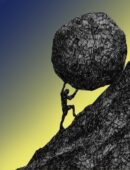
 ABOUT THE POEM: This poem builds a mythology around “Ronie Dinosaur,” a figure who isn’t a hero, prophet, or martyr, but a man who persists purely out of character. The piece exists in a world where action is stripped of romantic illusions. Walking becomes Ronie’s defining verb—not as escape, not as pilgrimage, but as a refusal to surrender. The imagery treats existence as a sentence, not a gift, and the poem’s tone recognises the gravity of living without cushioning it with faith, hope, or cosmic purpose. Death appears not as a frightening end but as an awkward, embarrassed follower—an entity confused by Ronie’s lack of fear. This reverses the traditional dynamic: instead of humans shrinking from mortality, mortality trails behind a man who simply does not find it worth acknowledging. The poem treats death as petty, even incompetent, compared to the vastness of suffering, consciousness, and self-awareness that define Ronie’s internal universe. The poem also leans into identity as a burden. Masculinity becomes a weight that no experiment has ever measured, yet it shapes the rhythm of Ronie’s walk. Every step he takes is heavy with unspoken grief, failed expectations, and the pressure to remain unbroken. The references to Arjuna and Shiva anchor the narrative in myth, but only to contrast Ronie with them. Where mythic figures walk with divine purpose, Ronie walks with nothing except habit, style, and the bleak dignity of surviving his own existence. The poem’s core question—what does a man deserve after so much suffering?—never gets a satisfying answer. The universe shrugs, death pockets the change, and the “house” keeps winning. Ronie’s only response is to keep walking. Movement becomes defiance; silence becomes judgment. The world offers no reward, so Ronie becomes his own. The walk is the character. The character is the victory.
Ronie Dinosaur walks alone-
not from necessity,
but from habit
and from style.
He moves down streets
where some girl might pause
and wonder,
“Did he even see me?”
The answer is no.
Not out of arrogance-
simply because his eyes
are fixed on a horizon
that burned out long ago.
When death finally comes,
he will not stare into its sockets
nor lower his gaze in defeat.
He will not acknowledge it at all.
Death will trail a few steps behind,
curious,
almost embarrassed,
like a stray dog
following a man
who has forgotten
he was ever meant to be afraid.
Ronie is hunting something else entirely-
something that was never born
and therefore can never die.
So death just tags along,
leashed by indifference,
while the dinosaur keeps walking
as if the world
were already extinct
and he is only passing through
to confirm the silence.
He is not Arjuna.
He acts-
not for duty, not for blame,
not for chains, not for desire,
not for ambition-
but because this alone can be done with character,
because this alone lets the man in my heart
match the one in the mirror outside.
He is no slave,
no king,
no god,
no worshipper.
He does not care
who remembers him
after the last footprint cools.
He knows who he is
while the blood is still warm.
Before birth I was nothing.
After death there will be none.
Between those two zeros
I am a man-
and that is the entire, unbearable problem.
The flesh is heavy,
the sentence is life,
and Ronie Dinosaur
serves it
without appeal,
without applause,
walking.
The effect on my heart of being a male
has never been measured
by any experiment
or anyone.
They ask, “Where would Ronie be?”
And they answer themselves:
Only two people know.
One is Ronie himself.
And the other-
that is also Ronie.
I keep walking
because stopping
would have been impolite.
With this burden and
the weight of my bones
plus the weight of my silence
multiplied by the distance
I have already walked
away from everything
that tried to make me smaller.
I walk out of habit and style.
Shiva once set out walking too-
grief in one hand,
a severed head in the other-
searching for spiritual fire.
Ronie walks for something larger
and infinitely more brutal for a human:
the thing that ought to have been his
after all this much suffering.
Death,
that larger, colder snake,
will try to cheat them both.
But my character
will not let me lose.
You may win the game-
but I will not let you
choose the rules.
I walk out of habit.
I walk out of style.
I walk
because the alternative
is surrender,
and surrender
is the only sin
Ronie Dinosaur
has never committed.
My grief is a receipt
stamped and dated.
It entitles me
to something.
Instead, death
pockets the change
and smiles.
What kind of sorcery is this
that lets the house always win
and still calls the game fair?
Ronie Dinosaur
does not ask twice.
He just keeps walking
until the question
walks itself
into silence.




[…] Ronie Dinosaur Chapter 0 – Where Would Ronie be? […]