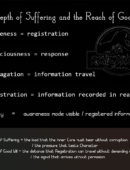












 ABOUT THE POEM: Guy Next Door is a first-person existential poem that traces the quiet erosion of a seemingly ordinary life. The speaker begins as an unremarkable, socially adjacent figure-“the guy next door”-whose initial desire is modest and conventional: to fall in love and be chosen. What follows is not a dramatic fall, but a gradual diffusion of purpose. Life becomes a sequence of “samples,” experiences accumulated without commitment, movement without arrival. The central metaphor of a test drive turning into a continental crossing frames existence as accidental overextension rather than intentional pursuit. The poem situates personal failure within cultural and spiritual imagery. The immersion of ashes in the Ganga suggests ritual closure, yet the speaker remains alive, unresolved, and bodily present-an inversion of transcendence. Physical intimacy appears stripped of meaning, described as contact without transfer, reinforcing the poem’s theme of hollowness rather than indulgence. As the poem progresses, the emotional narrative transforms into a spatial and philosophical one. The collapse of “height” signals the loss of transcendence, aspiration, and divine relevance. God is not rejected; God becomes unnecessary. The world flattens into pure horizontality, where mercy, status, and meaning no longer descend from above but fail to exist at all. The recurring image of margosa (neem) anchors the poem culturally and symbolically: bitter, medicinal, unloved, yet indispensable. The speaker aligns with this image-useful but unsought, impossible to romanticize. The final assertion, “This is not despair. This is geometry,” reframes suffering as structural rather than emotional. The poem does not ask for rescue or consolation; it presents a coherent internal physics of a life constrained by dimensions that never fully formed.
Guy Next Door
I was the guy next door-
simple, quiet, a little bright,
wanting to fall in love,
a girl to adore.
I went out for a test drive
and crossed continents.
I tasted a little of everything,
yet something stayed untouched.
My life vanished in samples.
Now tell me how to admit
it wasn’t what I wanted,
that another road
might have fit better.
Life burned the ghosts in me.
Their ashes went to the Ganga,
flowers floating like paperwork completed.
The body stayed behind.
I drag it toward the finish line,
hugging hollow bodies,
accepting this much truth:
love is not coming
to numb the pain.
Thirst stayed.
Hunger learned language
and accused me by name.
My heart-too proud,
too rigid-
never managed a single girl
without calculation.
How could this stubborn thump-thump
fail at the only thing
it was made for?
Now I remember myself
as something close to a monster:
not violent, not cruel,
just incapable-
unable to hold
what was fragile
without turning forceful.
I’m not sweet,
not salty,
not spicy,
not sour,
not tangy,
not bland.
No hope stored,
no dream deferred-
just me,
bitter as margosa bark.
My eyes stay level
with the dust.
The sky still exists,
but it is too far to matter.
In lived space,
one dimension has collapsed.
No height.
No above.
No ladder pretending to be prayer.
When height disappears,
possibility follows.
When possibility ends,
so does the search for God.
Not disbelief-
irrelevance.
A flat world needs no watcher.
Nothing descends here.
Mercy requires altitude.
I walk where planes end,
where meaning is no longer borrowed,
where respect is not promised,
where status cannot be gifted from above.
Like margosa-
medicinal, unloved,
too bitter to worship,
too necessary to remove
from the main door.
Cut me down
and the taste remains.
This is not despair.
This is geometry.