










 ABOUT THE POEM: “Shiva, Ram and Me” is a powerful analysis of two contrasting Hindu archetypes: Shiva, representing the untamed inner will (mann) and freedom from societal norms, and Ram, embodying ideal obedience, duty, and social form (maryada). The poem explores their reversed journeys toward wholeness and argues that while society demands Ram’s usefulness, true character requires balancing his discipline with Shiva’s wild, uncopied truth. The author concludes by positioning himself as an outsider who must simply bargain with the world using logic and mann.
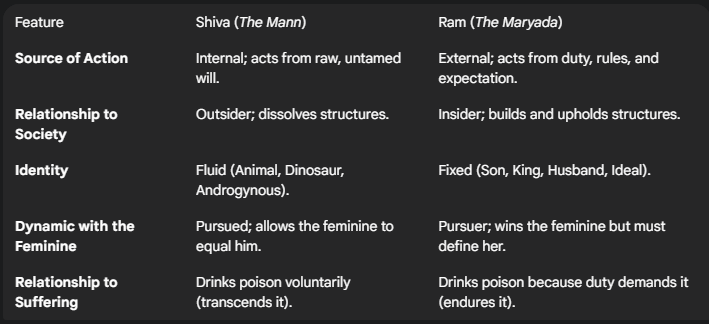
The stark difference between Shiva and Ram begins with the direction each chooses. Ram belongs to society; Shiva stands outside it. Yet they feel like twin expressions of one primal force, moving on different planes of existence.
Shiva listens only to the mann-the raw, untamed inner will. He bows to no one; insult or misunderstanding mean nothing to him. Ram listens to the voices around him, follows rules, and bows readily. Society crowns him the ideal because obedience makes him useful-an image sculpted perfectly for public worship.
Shiva carries no such burden. He can be animal, dinosaur, or Ardhanarishvara-half-woman, wholly free. He refuses the narrow cage of masculinity that society demands and ignores every game of approval. Whatever Ram builds within civilization, Shiva dissolves by simply being himself. Both arise from character, but Ram’s is shaped from the outside while Shiva’s rises untaught from within. The mann invents its own law; copied ideals do not. That is why Shiva has no avatars. He is not a replica, not a rebirth, not part of Vishnu’s line of refined societal images. Ram, the seventh avatar, is a continuation-son shaped by father, ideal polished by tradition.
Neither figure is complete alone. Shiva eventually enters society after wandering beyond it; Ram is exiled to the forest and learns freedom by force-two reversed journeys toward the same center. Each supplies what the other lacks. A woman becomes the bridge in this alchemy, because every person seeks to balance the wild inner Shiva with the disciplined outer Ram.
In the swayamvara hall, Ram pursues and wins Sita; desire begins on his side. Picture the scene: the clang of bowstring, the murmur of watching kings, the sharp intake of breath when the bow snaps. His victory is public, earned, performative. Shiva moves differently. He is pursued. Women worship him through the Shivalinga, meeting him as equals, not subordinates. Shiva allows, he permits the woman to feel the power through him. Ram-no matter how ideal he appears-still needs to hold power over the woman he wins. The wife is expected to bow; the worshipper of Shiva stands eye-to-eye with her god. Ram is desired as husband, son, brother-roles society can use. Shiva is desired for the Shivalinga itself: source, not symbol. People need Ram because they can possess his story. Shiva exists whether anyone needs him or not.
These are two modes of being: the wild interior truth (Shiva, the mann) and the socially sculpted identity (Ram, maryada). Wholeness comes from holding both without letting either dominate. “Who am I?” must flow into “Who are you?” just as Namaste answers Namaskar. Awareness is not isolation; it is the meeting of two truths.
Shiva drinks poison though he owes nothing. Ram drinks it because society demands sacrifice from its chosen ideal. And one day, when Ram is no longer useful, he will be left alone-just as Sita left him. People may argue that Ram abandoned her in the forest after a washerman’s words, but the point remains: society shapes Ram’s decisions, even when they destroy him. Shiva loses nothing when he walks away; Ram loses everything when others let go.
The lesson I learned from these stories is simple: I am neither Shiva nor Ram. I cannot win a woman in a swayamvara, nor am I desired like Shiva. I bargain. This world runs on blame and obligation, and I cannot disappear into myth. I take each step with mann and logic alone. And I also know, to preserve character, one must have strength.