 ABOUT THE POEM:
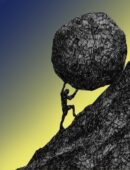
 “Job Description” sits at the quiet center of Spine of Barren Soil like a nameplate bolted to a wall that doesn’t need decoration. It rejects spectacle and ambition in favor of orientation. The speaker is not asking to be followed, admired, or forgiven. He is locating himself in a world crowded with performance and thin rewards, then continuing anyway. The opening lines deliberately flatten hierarchy. Building houses, raising children, and singing for likes are placed side by side without mockery. Each is presented as a legitimate human occupation. This matters because the poem refuses the easy trap of moral superiority. The contrast arrives gently: some “bear witness to the cost of standing up and speaking truth anyway.” Witnessing is framed not as heroism but as labor—ongoing, unpaid, and often unwanted. It carries consequence without guaranteeing change. The phrase “cost” does the heavy lifting. It implies loss, friction, and endurance rather than victory. Truth here is not a weapon or a slogan; it is something that exacts a toll on the one who carries it. By choosing witness over conquest, the speaker aligns with restraint and responsibility rather than domination. This is masculinity stripped of conquest myths—rooted in posture, not possession. Calling it a “job description” is a deliberate demystification. Jobs are repetitive. They don’t require constant inspiration. They are done even when no one is watching. This frames the speaker’s path as duty rather than destiny, removing the romance while preserving the seriousness. The line “This is not a boast of greatness” anticipates skepticism and disarms it, grounding the voice before it can harden into ideology. The final three lines function like an introduction without a handshake. “Hi” is disarmingly plain. Naming oneself is an act of accountability rather than branding. “I am walking” closes the piece without resolution, emphasizing continuation over arrival. There is no promise of reward, reconciliation, or recognition. Motion itself becomes the ethic. Placed alongside the larger song, this text clarifies the emotional architecture: love exists, but it does not excuse collapse; equality exists, but it is measured in giving, not claiming; masculinity exists, but it is defined by standing upright under pressure, not by being chosen. The speaker’s evolution is not toward softness or hardness, but toward precision—knowing exactly what his work is and doing it without noise. In that sense, “Job Description” is less a poem than a calibration. It tells the reader what not to expect—no spectacle, no pleas—and what will continue regardless: a man walking, bearing witness, paying the cost, and refusing to outsource responsibility.
Title – Job Description
Some herd cattle.
Some teach scholars.
Some raise children.
Some bear witness to the cost
of standing up and speaking truth anyway.
This is not a boast of greatness—
it is simply my job description.
Hi.
I am Ronie Dinosaur.
I am walking.