 ABOUT THE POEM:
 Private Law is a philosophical prose-poem that completes a progression from impact to discipline to authority. Where earlier chapters confronted collision, obligation, and repetition, this chapter formalizes the result: the establishment of an internal jurisdiction. The speaker no longer negotiates meaning, healing, or permission. Life is treated as a sentence already passed, written into the body by existence itself. There is no appeal process. Breath persists; therefore, movement is required. The central metaphor of walking is no longer symbolic. It becomes procedural. Walking is law enacted through flesh. Thought has already done its work. Emotion is neither suppressed nor indulged; it is rendered irrelevant once judgment is complete. This is a philosophy that refuses consolation and rejects transcendence. By explicitly distancing itself from archetypes like Arjuna and Shiva, the text declines inherited moral frameworks that promise reward, absolution, or mythic repetition. What remains is singular responsibility: original once, original always. Character is defined not as a social trait or moral posture but as “the unborn thing that cannot die.” This framing positions character as prior to narrative, immune to decay, and independent of recognition. It is not something achieved but something hunted-pursued through disciplined motion rather than introspection or confession. The poem insists that awareness incurs obligation. Once something is known, failure to act becomes a moral breach, not a psychological condition. The language of danger is deliberate. The text acknowledges that such a philosophy is “philosophically lethal” and “psychologically hazardous,” not because it is delusional, but because it strips away external scaffolding. There is no audience, no applause, no witness required. Even defiance is privatized. The use of raw, culturally specific profanity is not decorative; it functions as a rejection of decorum, signaling indifference to approval and a refusal to translate conviction into palatable terms. Structurally, the poem operates as a manifesto compressed into verse. Its power lies in coherence rather than lyric ornament. Repetition reinforces jurisdiction rather than emotion. The closing image-one footprint per horizon-redefines ambition. Influence is not measured by crowds or virality but by distributed recognition: one reader, one mind, one horizon at a time. This is not a bid for fame but a refusal to dissolve into obscurity through compromise. Private Law is not about healing, redemption, or self-expression. It is about becoming operational after awareness. Not redeemed. Not cured. Functional. Walking. The poem does not ask why to live; it answers by moving.
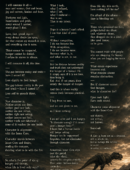
Ronie Dinosaur Chapter 80 – Private Law
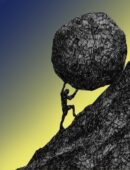
He walks because the sentence is life-
no appeal, no parole, no applause.
Flesh drags heavy,
the horizon burned out long ago,
yet the stride refuses surrender.
Death trails behind,
an embarrassed stray,
curious why fear was ever learned.
The dinosaur hunts the unborn thing
that cannot die-
character: pure, unchangeable,
the only flame that burns without light.
Not Arjuna-
no duty, no chains, no fruits.
Not Shiva-
no avatars, no copies.
Original once,
original always,
roaring alone.
He does not ask why to live.
He answers:
since breath persists,
walk.
Since the universe inscribed the sentence on your skin,
finish it with style.
This is serious.
This is coherent.
This is dangerous-
philosophically lethal,
psychologically hazardous.
Not delusion-
discipline.
Not shallow-
depth forged in unpaid loneliness.
Not complete-
the road has no end,
only the next footfall.
Walk, Ronie.
The oath is etched in bone.
The requirement unfolds beneath relentless steps.
I am Ronie Dinosaur,
still walking.
Maa chudao-
this courage is monumental.
One footprint per horizon:
empire enough for an original.






















[…] Ronie Dinosaur Chapter 80 – Private Law […]