 ABOUT THE POEM:
 This chapter exists in the aftermath of realization, not discovery. The speaker is no longer trying to understand what happened; he understands it completely. What remains is the accounting-of time, of intent, of the cost of holding oneself to a code that the other person neither shared nor recognized. The poem is written from the position of someone who did not fail to love, but failed to be legible in the language of love that was expected of him. The central idea of love without witness is not that love went unnoticed by accident, but that it was structurally invisible. The speaker’s affection was governed by character: restraint, patience, refusal to convert feeling into demand. In a world where love is expected to announce itself through emotion, pleasure, gifts, or social proof, this kind of love leaves no trace. It produces no spectacle, no memory that can be pointed to later and called proof. What remains is loss without evidence. The poem contrasts different economies of love. There is the economy of emotion, which spills and is publicly readable. There is the economy of the flesh, which validates itself through pleasure. There is the transactional economy of money, class, and gifts, where affection arrives wrapped and acknowledged. Against these, character-based love has no currency. It cannot be displayed, returned, or even properly refused, because it never formally presents itself. The quoted rejection functions as a rupture. It is deliberately crude, not because the speaker wants to shock, but because it clarifies the mismatch instantly. Appetite speaks a language character does not. The violence of the statement is not sexual but ethical-it establishes that the speaker’s restraint was not misread as respect, but as absence. The returned poem is the key artifact. It is not torn, mocked, or destroyed. It is politely handed back, which is worse. The gesture denies intimacy retroactively, treating the offering as misplaced property rather than an act of exposure. The adjective “impolite” matters here: it signals not rudeness, but a failure of moral recognition. The ending refuses consolation. Time does not heal or redeem; it simply becomes the only witness left. The “wasted years” reading the poem suggests that meaning arrives too late to matter. The poem is not asking for sympathy or correction. It is a record of what happens when a person chooses dignity in an environment that only responds to display. This chapter fits into a larger arc concerned with selfhood, ethics, and endurance. It does not argue that character guarantees love. It argues the opposite: character may cost you love, and still be the only way you can live with yourself afterward.
Ronie Dinosaur Chapter 103 – Reflection: Love Without Witness
I loved you with character.
I still do.
Love poured from the heart
spills as emotion, visible to all.
Love from the flesh
reveals itself in pleasure.
Love bought with money, class, or gifts
arrives wrapped,
held in open hands.
But love given by character
is never felt by the receiver,
has nothing to display-
only the quiet loss
of something never recognized.
And I walk alone.
No one has ever asked my broken heart,
“How are you faring, my love?”
They are long gone.
No love returns from the past.
She felt neither emotion nor pleasure-
all of it held back by careful restraint.
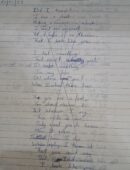
I gave her a poem on a sheet of paper.
She returned it, saying,
“I had this somewhere; I must give it back.”
She never came back-
swore instead, crude and final:
“I’d bury myself in the earth or a thousand strangers’ beds
before I’d ever be yours.”
And she left.
What I called love
was only the illusion of my own eyes.
Who else can be blamed?
The poem flutters back like a dead leaf,
ink already fading from her impolite hands.
I pocket the silence it carried,
walk on with the weight of unheard lines-
and let the wasted years read
what no one else ever did.


















[…] Ronie Dinosaur Chapter 103 – Reflection: Love Without Witness […]