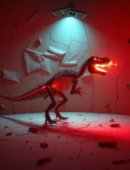







 ABOUT THE POEM: This piece builds its entire architecture on the idea of Shiva as negation—not the deity of myth, but the metaphysical principle of what remains when everything else erodes. Shiva becomes the symbol of presence-through-absence, the weight of a ghost that outlives the body, the moral pressure exerted by someone who exists more powerfully in silence than in life. The speaker—naming himself Ronie Dinosaur—mirrors that ontology. His identity does not form through society’s machinery but through solitary grief, the way rock is shaped by time, not tools. The poem treats grief not as an emotional episode but as an ontological state: a mode of being, a definition. The snakes—interpreted as obligations, disciplines, self-imposed austerities—tie the speaker to a path that feels ancient, ascetic, and privately mythic. The tone is not devotional but existential; Shiva is used as a philosophical device to explore the paradox of identity discovered through absence, silence, and loss. The poem’s power lies in its refusal to flatter life. It describes a character forged through negation, through the pressure of presence that is no longer there, and through the weight that absence leaves behind.
The absence of Shiva-
the ghost of him-
weighs heavier
than Shiva ever did in his own body.
He kept watching,
acting dead,
as if studying how not to be,
as if testing who I am-
measuring the shadow
even when I wasn’t there to cast it.
When I wouldn’t be,
only then would I know what I am,
who I am.
Presence, repeated long enough,
turns into ownership-
a moral claim earned by persistence.
The ghost heavier than the body.
And the sorrow darker than the anger.
Body and form are not Shiva.
What remains after losing them
is Shiva.
That is the truth.
What is the thing
that is present only through its absence?
Shiva.
The one who is dead
while he is alive.
And thus I am grief.
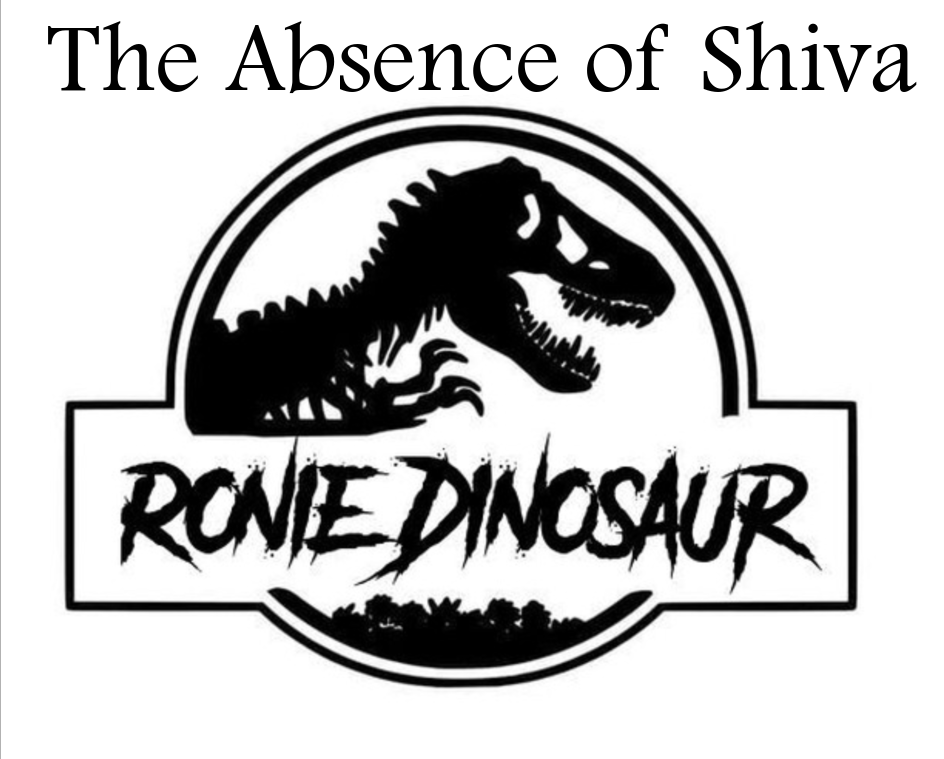
I am Ronie Dinosaur.
I am original-I have no copies, no avatar.
Snakes-these bonds, blames and obligations-give me company,
keep me in discipline.
They might have come by their own will,
but now they cannot go
until I say so.
This character-
I do not forge it in the machinery of society;
I discover it in solitary grief.
No dog or cat or any other pet,
neither wife nor kids,
no mother or sister or brother,
no friend, no girlfriend,
no female companion of any kind,
no god, no father,
no home and no whereabouts.
No one ahead or behind,
above or below either.
I am the one deprived and lonely by decision.
I walk alone out of habit and style.
I don’t hope, pray, or dream,
and I am a godless being.
I don’t beg for it,
and no one is giving it either
when I don’t have it.
That’s the struggle.
That is the grief.
I didn’t want what I only wanted;
I wanted what ought to have been mine by right.
https://t.co/1YkMyfeQE5 #TheAbsenceOfShiva #RonieDinosaur #MaleLoneliness #ChosenLoneliness #SolitaryMan #ModernMasculinity #Shiva #Grief #Poetry #SpokenWord #Godless #WalkAlone I didn’t want what I only wanted;
I wanted what ought to have been mine by right. pic.twitter.com/wteo15Xfam— Navodit Kumar (@ronie_dinosaur) November 30, 2025