






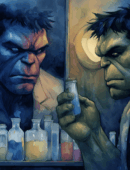

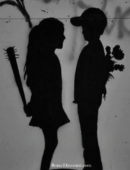



 ABOUT THE POEM: Chapter 53 sits at a critical pressure point in the book. Earlier chapters orbit loss, invisibility, and delayed understanding; later chapters harden into stance. This one is the moment where motion resumes—not triumphantly, not optimistically, but mechanically and honestly. The line “the tough gets going” is not motivational; it is descriptive. Movement happens because stasis has become unbearable, not because hope has arrived. The opening imagery strips the speaker to essentials. Time has already done the worst: it has removed possessions, relationships, and illusions. Depression here is not dramatized; it is treated like terrain. The climb out of the pit is slow, bodily, and unobserved. Crucially, the ascent is not performed for redemption or recognition. “Only for myself” establishes a central ethic of the book: action without witnesses still counts. Meaning does not require applause. The Bryan Adams reference is not nostalgia for fame or success, but a recognition of voice. “Here I am—this is me” becomes an assertion of presence, not identity polish. Immediately after, the poem undercuts charisma: style and swagger get attention; character does not. This tension—between what registers socially and what endures privately—runs through the entire work. The meditation/prayer passage is one of the chapter’s philosophical hinges. Meaning outsourced to God or narrative is contrasted with awareness without interpretation. This is not anti-spirituality; it is anti-mediation. The speaker is done borrowing meaning. The vulgar line about money and sex is intentionally jarring—it collapses lofty pattern-seeking into crude transactional reality, exposing how often “signs” are just rationalized appetites. Time emerges as the real antagonist. Wisdom arrives too late to be useful, experience feels like a rigged game, and moral purity is likened to tin foil—single-use, fragile, permanently damaged by repetition. The Newtonian metaphor of delayed reactions in relationships underscores a bleak temporal irony: recognition comes only when desire has expired. The chapter refuses self-exoneration. “They won because my character was the weak link” is not bitterness alone; it is an admission that character does not compete well in utilitarian systems. Others optimized, adapted, discarded. The speaker did not. This is framed neither as moral superiority nor victimhood, but as consequence. The AI passages widen the scope. Humans have character; AI will have coherence. That distinction matters. Character is costly, inconsistent, and socially inefficient. Coherence scales. The future belongs to systems that optimize logic, not to individuals who bleed privately. When a robot calls the speaker “a bag of blood,” the insult lands because it is accurate in a world that increasingly values function over essence. The chapter ends without resolution. The repeated “no” is not just romantic rejection; it is social refusal, existential denial. Yet the speaker is still standing. Still human. Still moving.
Ronie Dinosaur Chapter 53 – The Tough Gets Going
When the going gets tough,
the tough gets going.
After time has stripped everything bare-
possessions, people, illusions-
that’s when, in the thick of depression,
I throw off the blanket heavy with dust,
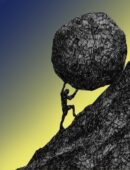
crawl from the gutter, the pit, the deep well
where echoes mock me.
Slow motion:
fingers grip the edge,
knuckles white,
breath ragged in the cold dawn.
I pull myself up-
not for applause,
not for rescue-
only for myself.
Let this count.
Let this matter.
And somewhere in the distance,
Bryan Adams’ gravel voice rises:
“Here I am-
this is me.”
The tough gets going.
Character is invisible,
my style, my swagger – that’s the hit.
Prayer and meditation –
the difference lies between
understanding meaning through someone (God) or something (a story) else,
and realizing the self without analysis –
the awareness of being, without needing meaning.
Prophets are messengers, the religious say.
Writers say the world bends itself
to please one’s want.
Patterns are everywhere – just read the signs, take the hints.
It’s such a beautiful round world: give money, take ass.
There’s no reason to live, and death is inevitable.
At the end of a book, even if there’s a conclusion,
the time has already gone by.
Wisdom comes too late –
if I learn in my forties what I needed in my twenties,
what use is this experience, seemed like a scheme?
The purity of man is like tin foil –
made to wrap food once,
not again and again,
until it’s crumpled beyond shape.
To every action there’s an equal and opposite reaction –
I think of the women of my life in my forties,
they’ll think of me too,
in their sixties,
when they finally have time from kids.
They won because my character was the weak link –
their skill to choose what’s useful, to form over time,
leaving old things like character – and people like me –
irrelevant.
That got them places
while I kept roaming broken forts.
I didn’t change.
I couldn’t. But I didn’t move
until they said,
“Why would I call anyone like you?”
I was a broken heart once.
Now I understand how to show it –
and what to make of it.
Everything remains as it is,
me and character both,
still useless,
still invisible.
I can die, but I can’t change.
It’s my inability as well as the ability.
Don’t just stand there in the audience
and giggle at my misfortune –
I’m still alive, not dead yet.
Particles have properties.
Celestial objects have gravity.
Humans have character.
AI will have coherence – the moral geometry of its own logic.
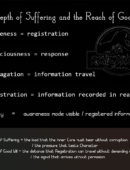
Experience gives awareness, then it becomes thought.
Thoughts mixed with data become information,
and with interpretation, it becomes knowledge.
Knowledge upon judgment becomes wisdom –
knowing when to act beyond profit or loss.
If you would ask me, in this garden of guesses,
what seed would you plant next?
I might just deny standing beside a superintelligent robot,
or walk in a world where my originality
is second to tin boxes.
Standing alone on wandering streets,
where tiny sparks – stars in the sky –
outshine the soul’s faint flicker,
I am human.
Then someone shouts,
“Hey, you bag of blood!”
To my surprise – it was a robot.
The number of times
I’ve heard “no” spat in contempt-
even the word itself
has never been uttered so often.


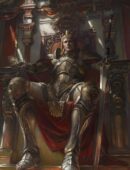








[…] Ronie Dinosaur Chapter 53 – The Tough Gets Going […]