 ABOUT THE POEM:
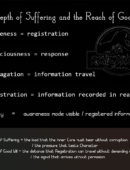
 Hierarchy and the Human Condition presents a personal moral architecture rather than a social doctrine. It does not argue how people should live collectively; it articulates how one individual chooses to remain internally coherent in a world that rewards compromise, approval, and emotional dependency. The poem is rooted in existential realism: meaning is not inherited, granted, or discovered externally-it is maintained through alignment between inner will, character, and action. At the foundation lies the mann, the heart understood not as emotion but as the true will-an internal orientation where desire is not appetite but alignment. This is a critical distinction. Hunger reacts; alignment commits. The poem asserts that when character faithfully expresses this inner law, the individual approaches a state symbolized as godhood. Shiva is invoked not as an object of worship but as a psychological archetype: a being complete within itself, untouched by need, self-sufficient in meaning. This is not mysticism but symbolic language for inner sovereignty. Below this level stands the disciplined human, represented by Ram. Unlike Shiva’s ontological completeness, Ram’s elevation comes through restraint, duty, and moral discipline. This reflects a stoic ethic: character refined until it governs instinct. The hierarchy here is not about superiority of worth but about modes of being-self-contained alignment versus disciplined participation in the human world. Respect follows as a social currency. The poem treats respect with skepticism, not contempt. Respect requires character, but it is external, conditional, and unstable. It is “borrowed light,” often mistaken for meaning. The critique is clear: many organize their lives around recognition and die defending it, confusing visibility with value. Love occupies an unresolved position. It is acknowledged as potentially arising from the true will of the heart, but it is also transient. The speaker emphasizes continuity of self before and after love, refusing to place love as either foundation or summit. This is psychologically grounded: attachment can enrich existence, but identity built upon it collapses when it leaves. The poem chooses persistence over emotional centrality. The final movement confronts consciousness itself. Consciousness is portrayed not as a moral guide but as a survival mechanism, capable of overriding values when necessary. The cost of such overrides-compromise, bargaining, internal fracture-is paid by the individual, not by consciousness. This recognition anchors the poem firmly in the human condition: awareness without consolation, responsibility without external absolution. Ultimately, this work articulates an ethic of self-responsibility. It anticipates misunderstanding-ego mistaken for arrogance, discipline labeled pride-and accepts isolation as a consequence rather than a tragedy. The hierarchy described is not aspirational for the masses. It is a declaration of how one person chooses to stand upright, intact, and answerable only to the cost of being human.
Ronie Dinosaur Chapter 83 – Hierarchy and The Human Condition
The heart reigns first-
the mann,
the true will within,
where desire is not mere hunger
but alignment.
Whoever walks in lockstep
with that inner law,
whose character unveils
what the heart already knows,
stands closest to godhood-
not worshipped,
but becoming,
like Shiva: complete in solitude.
Below that rises
the disciplined human-
Ram among men.
Not divine by birth,
but exalted through restraint,
character honed
until it eclipses raw instinct.
Next comes respect-
the coin most chase,
live for,
die for,
mistake for meaning.
It demands character, yes,
but borrows its light,
never births it.
And love-
I place it cautiously.
Love may spring
from the true will of the heart,
or merely visit.
But love departs.
Before love, I endured.
After love, I endure still.
Thus, love claims neither summit
nor foundation.
The heart does.
All of these walk with character.
And character exacts isolation-
or discovers it,
given time.
People brand it ego.
Discipline becomes arrogance.
They bow to gods for provision,
to hope for salvation,
to excuses and shortcuts.
I bow to none.
My consciousness cares not
whether I honor my heart’s will,
ride my character like a jockey,
or earn respect.
Its only drive is to perpetuate itself-
to keep this body breathing.
It overrides rules when survival demands,
forces bargains with my character.
That bargain carries a cost-
paid not by consciousness,
but by me alone.
This is the human condition.
Between two points of reference-
humiliation
and respect
in my own eyes-
that is who I am.
That is the weight.
That is my character.
Neither action nor duty,
neither good nor bad,
neither sin nor virtue,
neither right nor wrong,
neither truth nor falsehood-
none of it touches the one inside.
It neither gets wounded
nor grows.
It does not fall in love
or hate.
It is within me,
without cost.
It carries me with it,
and I with it.
It is my character,
the true will of my heart,
my soul.





















[…] Ronie Dinosaur Chapter 83 – Hierarchy and The Human Condition […]