 ABOUT THE POEM:
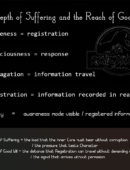
 Chapter 140 – Response This chapter marks a structural turn in the book. Until now, First-Order Truth has largely concerned itself with endurance, formation, refusal, and the long walk taken without guarantee of recognition. Chapter 140 does something more dangerous: it interrogates whether endurance alone is sufficient for a human being. The chapter begins with a blunt premise: character that exists only to itself is incomplete. Not false. Not weak. Incomplete. This is an important distinction. The text does not argue that character requires validation to exist; it argues that a human life requires contact to remain human. This places the chapter outside conventional moral philosophy and self-help frameworks, which often insist that inner integrity is enough. Here, integrity is treated as necessary but insufficient. The concept of mann becomes central. Mann is defined not as character, but as the awareness from which character emerges. It is the conjunction of subconscious depth and active heart-awareness paired with will. Character is downstream. Mann is upstream. This distinction matters because character can become rigid, self-contained, even sealed, while mann remains interrogative. Mann asks questions character cannot answer because character already is. From this framing emerge the five paths hinted at across earlier chapters: creating, finding, sharing, teaching, buying. Each is presented not as moral failure but as a human attempt to resolve isolation. The chapter refuses to romanticize any of them. Creation may fail. Finding may fail. Teaching may fail. Even transaction-the most pragmatic compromise-corrupts both parties while still leaving the core hunger untouched. The admission of alcoholism is not included for confession or sympathy, but as evidence: a structural response to unmet contact, not a character flaw in the moral sense. What sharpens the chapter is its rejection of fame as the fifth path. Fame is explicitly dismissed as spectacle, not response. The chapter instead defines response with precision: response is external evidence that one’s existence has intersected reality. Recognition is internal; response is not. This distinction avoids narcissism while also refusing ascetic disappearance. The line “Did I trigger response?” is not a cry for approval. It is closer to an engineering diagnostic. Did this force register? Did it deform anything? Did it leave a mark beyond itself? The chapter argues that internal certainty cannot manufacture external response, and external noise cannot generate internal recognition. They are orthogonal. Both must exist independently. Virtue is stripped of authority here. Not rejected, but rendered irrelevant. Virtue kneels; character does not. This is not anti-morality; it is anti-performance. Virtue is shown as something that often requires an audience to function. Character, in this text, functions even when it annihilates its own comfort. This is why the chapter insists that a man of flawless character can still vanish. History confirms this. Integrity does not guarantee trace. The chapter’s most important move is introducing contact as the layer beyond character. Not approval. Not admiration. Not fame. Contact. A single real response outweighs a thousand silent virtues because response proves interaction. It proves the walk has not become a closed circuit. Without contact, mann risks collapsing inward, becoming self-referential, no matter how disciplined. By framing response as evidence rather than reward, the chapter avoids both bitterness and entitlement. It does not claim the world owes recognition. It asks whether the walk is still interacting with the world at all. This is a structural question, not an emotional one. The ending reinforces this by reasserting hierarchy: mann → character → walk. Character continues the walk, but mann retains the authority to override even what character once declared sacred. This prevents ossification. It prevents the text itself from becoming doctrine. In the larger arc of the book, Chapter 140 functions as a stress test. It checks whether the philosophy can survive contact with hunger, time, addiction, responsibility, and failure-without retreating into either martyrdom or spectacle. It neither resolves the question nor pretends to. It records it. That restraint is the chapter’s real strength. It does not conclude. It registers.
Ronie Dinosaur Chapter 140 – Response
Only I know my character.
And if only I know it,
then character alone is not enough.
So what would an original want
to live, not just exist?
Another original.
He would try to create one
if he could not find one.
And if he could neither create
nor find,
he would turn inward.
Who am I?
The answer is not character.
Character is already formed.
The sharper question is:
What am I,
and what am I not?
Awareness is mann.
The subconscious,
joined with the active heart.
Character is born from mann,
but mann is not character.
Because mann is aware,
it can choose-
to reveal or to withhold.
A fake does not have this option.
It cannot choose its reality.
It must perform.
So what would an original want
when creating fails,
finding fails,
and sharing fails?
Even alone,
he would try to turn fakes
into originals
by teaching them
what “original” means.
That is one path.
Whether it works or not,
time decides.
But character alone
is still not enough.
If creating fails,
if finding fails,
if sharing fails,
if teaching fails-
then what?
I am still lonely.
Still hungry.
Still thirsty.
My acknowledgments
receive no response.
I am human.
Time is limited.
The question does not leave:
Who am I?
What am I?
So I return to society-
not for belonging,
but for transaction.
You give me company.
I give you money.
No one wanted me
for what I was.
So I accepted the deal.
Now I carry a flaw.
Now I am an alcoholic.
I am guilty.
Walking on these paths by now,
have filled me with-
anger, grief and humiliation.
If the question is mine,
the answer already lies within me.
I am no longer only
a victim of loneliness.
I am also responsible.
I left the flaws behind,
when I realized,
I have nowhere to hide.
So if creating fails,
finding fails,
sharing fails,
teaching fails,
buying fails-
what remains?
The fifth way is not fame.
It is response.
Character does not seduce.
It confronts.
Did I trigger response?
Response is external.
Recognition is internal.
No amount of noise outside
can produce recognition inside.
No amount of certainty inside
can fake response outside.
So the question sharpens:
Has this registered in reality,
or am I still speaking into vacuum?
Character says:
I will not bend.
I will not fake.
I will not dilute.
Virtue says nothing here.
Virtue is irrelevant
to a man with character.
A man of character
does not bend even to virtue.
Mann asks:
Where does this force point?
Is it touching the world,
or only circulating within?
A man can have flawless character
and still disappear.
History is full of such men.
So beyond character lies contact-
not approval,
not fame,
but evidence.
One real response
outweighs a thousand silent virtues.
And what is a man without a heart?
But a man of character
needs more than heart.
He needs mann-
awareness joined with will,
subconscious joined with action.
From mann, character is formed.
From character, the walk continues.
Virtue can kneel.
Character does not.
Mann can override anything character
thought was undeniable, indispensable.























[…] Ronie Dinosaur Chapter 140 – Response […]