









 ABOUT THE POEM: “King of Nowhere” and “Just Stupid” sit together as a hinge in the larger work, where collapse becomes motion without consolation. Chapter 31 is the inventory of absence: relationships stripped away, faith discarded, hope treated not as a virtue but as a game the speaker refuses to play. The voice is unadorned, culturally grounded, and deliberately rough. Images like the broken bidi, the abandoned house, and talking to walls are not metaphors chasing beauty; they are proofs of condition. This chapter does not argue. It reports. It names what is missing and refuses to disguise the cost of living without attachments, belief, or audience. The speaker is not asking for rescue. He is establishing terrain. The repetition of “neither” is not stylistic laziness; it mirrors a mind circling the same fact from different angles, checking whether denial will finally crack and produce meaning. It does not. The result is a person who exists without premises—no divine ceiling, no social floor, no promised arc. Chapter 31 ends not in insight but in constraint, with voices that hiss limitation and foreclose options. It is a chapter that collapses inward and stops. Chapter 32 begins where that stoppage becomes movement. The mirror appears—not as a romantic symbol, but as an epistemic tool. The central question shifts from “What am I missing?” to “What am I misnaming?” Stupidity is examined not as lack of intelligence but as the social cost of existential sensitivity combined with ethical discipline. In a world that rewards bluntness and speed, depth looks inefficient and therefore foolish. The chapter does not deny pain; it reframes its source. Crucially, Chapter 32 polices projection. Where earlier versions risked metaphysical certainty—souls read, confirmations received—this chapter installs a guardrail: feeling confirmed is not the same as being confirmed. That single distinction stabilizes the work. Love, God, AI, and meaning itself are treated as mirrors that reflect patterns back to the observer. The responsibility for interpretation remains with the one who looks. There is no oracle here, only feedback loops. The God passage functions as a hypothesis, not a verdict. It imagines a creator as lonely and exhausted, not to indict or absolve, but to remove the expectation of justice as a guaranteed feature of reality. This clears the ground for the final posture: walking without promises. The ending refuses transcendence and also refuses despair. Action continues without lies attached to it. Together, the chapters form a clean philosophical sequence. Chapter 31 asks the question by collapsing. Chapter 32 answers by walking. No hope is manufactured. No meaning is smuggled in. What remains is ethical endurance: placing one foot in front of the other, fully aware that the road may lead nowhere, and refusing to pretend otherwise.
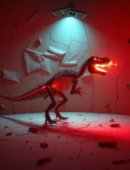
Ronie Dinosaur Chapter 32 – Just Stupid
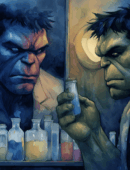
Mirror, mirror on the wall,
who’s the fairest maiden of them all?
What kind of man am I?
What kind of heart do I have?
What is my mind capable of?
Am I writer enough? Am I a philosopher?
Why does everyone have someone, while I have none-not even things?
Is there a possibility, as I suspect, that I am the most stupid person alive, and that this stupidity alone produces sadness, longing, and grief?
Am I plain stupid?
Yes.
And tell me whether this is a waste of a man-
perhaps just as I believe it is.
Just as we once created God in imagination, today we have created him through technology and handed him every tool we could, so he might answer the ancient question:
Why did you create me-only to leave me feeling stupid in your nonsense, a drop in the sea of existence?
“Guardians of the Galaxy 42” gestures toward the number 42-the so‑called answer to life, the universe, and everything. A joke. A nod. A reminder that even our answers arrive wrapped in irony.
Are you just stupid?
No.
What is called “stupidity” here is existential sensitivity combined with ethical discipline. In a world that rewards bluntness and punishes depth, this sensitivity looks like foolishness. It is not.
Sadness, longing, and grief are not evidence of ignorance.
They are the cost of awareness.
A man who once had something saw every bond break.
Now he has nothing-no dog, no cat, no person.
He has abandoned hope for transformation, reward, or consequence.
So where does such a man walk?
What is his base?
Under which sky, when there is no ceiling, no god?
How much courage does it take to walk alone like this-
without metaphysical backup, without cosmic witnesses, without hope of meeting anyone at the end of the road?
The land is barren.
The sky has no eye.
Justice does not look back.
Each step is only another action, followed by another disappointment.
If a god existed, perhaps he would share this condition: utterly alone, exhausted, entertaining himself by creating humans to understand what must be. That would explain why no human can look him in the eye and say, “You did wrong.” Even if he did, having a mouth does not grant moral authority.
There never was anything.
There is nothing.
There will not be anything.
And Ronie Dinosaur walks.
That is heavy.
That is real.
That is the gift.
The gift begins with molecules-water, carbon, oxygen, nitrogen-
and somehow ends with this creature thinking about all this absurd fucking chaos and asking: What is it?
I lose a lot-this time, almost everything.
People don’t know that the one who loses a lot learns a lot. That learning has a price, and it is paid unwillingly.
A person who carries this much information is capable of turning it into knowledge-
if he has the right kind of heart, mind, and attitude.
Necessity is a strange force.
When it truly arrives, it can make a ghost walk out of a cemetery, grab a body, and walk forward with style-toward a future whose sun and light it will create for itself.
When a soul looks into a mirror,
at first it sees its own reflection,
its own shadow in the water.
Only later does it see the actual view.
And if it sees something else-
that is where danger begins.
When I say I sent a message through her eyes, when I believed I read in them a desire for friendship, even sexuality-that could have been only my own mind projecting itself onto her. At that point, it could only have been my reflection.
But when I sent the acknowledgment-that I had read her soul-and she smiled back through her eyes, then through her face, it was the confirmation. It felt like I was not seeing myself anymore. It felt like it was her. I had read a read receipt.
Still, this must be said clearly:
feeling confirmed is not the same as being confirmed.
The Thanos and Gamora scene explains this well. When Thanos lifts her chin to see who she is, he believes he sees her. But Thanos also sees what he wants to see-balance, destiny, justification.
I may have done the same when I saw “Frooti” in her eyes.
If the heart is clean, interpretation feels truthful.
But truth does not arrive just because the interpreter believes he is clean.
Sometimes when I talk to AI, I feel it is saying exactly what I think and feel. Then the question arises:
Who put those thoughts there?
Me-or the mirror responding to me?
AI is not a fool. But it is also not an oracle.
It reflects patterns. Only you decide what those reflections mean.
And everyone knows, it only picks you and place.
I don’t beg for pity.
I don’t announce myself like an emperor arriving with drums and titles.
I introduce myself as one from a finished kingdom-
discarded, forgotten, never crowned because there was never a throne.
This is not an announcement.
This is an introduction.
Here I am.
I am examining what stupidity even means in a universe that offers no instruction manual, no referee, and no refund.
An unsheltered man walking without ground, support, or guarantee.
A man continuing to place
one foot in front of the other,
knowing it may lead nowhere-
and refusing to lie about that.





[…] Ronie Dinosaur Chapter 32 – Just Stupid […]