 ABOUT THE POEM:
 This poem explores the tension between desire and constraint, fantasy and fact, without appealing to transcendence or moral rescue. It begins in a state of displaced intimacy—talking to snakes, thinking of “her” only later—suggesting a mind that processes experience out of order, after the damage has already occurred. The recurring images of bars, branches, and unreachable wind establish a quiet confinement: the speaker is not only trapped by circumstance, but by physical laws that refuse negotiation. The middle movement widens the lens. Life is described as vast not in a romantic sense, but in a cruelly neutral one—large enough to accommodate both impossible dreams and the unchanging face of truth. Memory descends like stairs: college, school, rehab. Each return strips something away—status, innocence, stability—until only residue remains. “Soul-ashes” are not metaphysical; they cling, like dirt, to the body. The final section grounds anger in specificity. Instead of abstract enemies, the poem presents ordinary figures who persist unchanged: an animal, a dealer, an absent friend. None are dramatized; none are resolved. The poem refuses revenge, consolation, or redemption. Its purpose is not to heal, but to stand clearly within first-order reality—what is, continuing to be—without pretending otherwise.
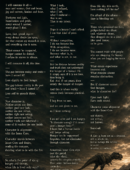
Title – Monstrously, Monotonously Vast
Sometimes I talk to snakes,
and sometimes I think of her-
only realizing it later.
Through iron bars, the moon,
snagged in black branches.
I wondered: what if she were mine?
Then reality struck:
I can’t even touch the wind outside.
Life is monstrously, monotonously vast-
vast enough for every impossible dream
and the dull, unchanging face of truth.
Descending the stairs,
I felt the old chill return-
thin and shaking as from college, degreeless;
my heart already weeping as from school;
and lately, the dry burn of rehab,
soul-ashes still clinging to my shoes.
I tell myself: no revenge.
What comes will come unforced.
But what do I do with this anger?
The same stray dog that bit me as a child
still circles the yard;
the woman who sold me the last fix
smiles from the corner;
the friend who never visited
passes on the street without a word-
a life unlived,
wrongs walking at my side.