 ABOUT THE POEM:
 “Sorcery” is a confessional myth written in the key of restraint rather than conquest. The speaker returns “having lost,” but refuses the cheap arithmetic where loss equals failure. The will to live by one’s own code is the victory condition here. This matters, because the poem positions desire against discipline and tests whether character can survive rejection without mutating into resentment. The central metaphors do the heavy lifting. The swan stands for a form of love that eats slowly, if at all-abundance in spirit, scarcity in appetite. The peacock, by contrast, performs, consumes, and is rewarded by a social order that confuses display with value. This is not a gender screed; it is a critique of incentives. The “feast” happens with “permission of the meal itself,” which indicts the system rather than demonizing individuals. Desire circulates where it is legible and rewarded. Consent and ambiguity sit at the moral fault line. The speaker practices restraint-no touch without certainty-while the other party traffics in mixed signals. Body language promises what words never ratify. The poem does not claim entitlement; it interrogates confusion. “What felt mine through her body language-was it not mine by word of mouth?” is the ethical question, not a verdict. The answer implied by the outcome is no: words outrank signals. The pain comes from discovering that clarity is the only currency that counts. The line “This has nothing to do with Kaliyug” refuses cosmic excuses. No age, no myth absolves personal responsibility. The loss is intimate, specific, and unglamorous. Rejection arrives cleanly only at the end; until then, ambiguity functions as a solvent, dissolving boundaries while preserving deniability. The speaker’s final severing-“don’t talk to me ever”-is less cruelty than triage. It is the moment where self-respect overrides longing. Stylistically, the poem blends aphorism with narrative, confession with allegory. Its rough edges are intentional; the voice wants honesty more than polish. Where it risks trouble is in proximity to grievance. It avoids collapse by insisting on agency and by refusing to eroticize victimhood. The speaker wants neither what he merely desired nor the consolation of blame. He wants coherence. Read alongside your broader project, this piece argues that character is action under uncertainty. Love without clarity corrodes both parties. The sorcery is not seduction; it is the spell of ambiguity-and the counter-spell is restraint.
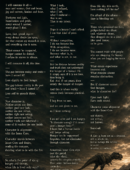
Sorcery
I came back having lost-so who has ever come back having won?
I lived by my own will; this is not called losing.
I became Ronie to the whole world-from five-year-old children to everyone at the table, at the door, or on the floor.
In return for the love I gave the boy within me, I could not gather love from a girl for myself.
The generosity of my spirit, my character in action, my golden intent-and yet my desire proved fruitless.
This has nothing to do with Kaliyug.
The swans do not know-they never knew how to eat.
They were not in the habit or style of eating with scarcity in life, but in love-while peacocking monsters devoured the feast with the permission of the meal itself.
The love of a swan is no game to be won.
He did not touch her until he was sure the hand he would hold would be his forever.
While displaying calculated affection, a chosen return held meaning for her.
She flinched, but allowed others.
It was not a common task, not the usual way for a girl accustomed to people like peacocks.
She rejected him.
He said, “What was that before? Now don’t ever talk to me.”
And she never came back.
I didn’t want what I merely desired.
I was only asking: what felt mine through her body language-was it not mine by word of mouth?
Every day when we met, she never called me to come to her, never asked me not to leave when we were friends. She just grabbed me, held me by force—it felt good. But she didn’t say yes when I asked her to be my girlfriend. She was an expert in ambiguity.