 ABOUT THE POEM:
 This poem operates as an existential ledger rather than a lament. It does not seek consolation, validation, or rescue; instead, it records debts that were never paid-emotional, moral, and social. The speaker positions himself not as a victim of circumstance alone, but as an agent trapped in a relentless practice of self-examination. Calling himself a philosopher is not a boast; it is an indictment. Philosophy here is labor, not prestige. Its function is to keep wounds “warm,” preventing forgetfulness from offering cheap relief. The repeated insistence on remembering failure reveals the poem’s central ethic: understanding matters more than comfort. Forgetting would be mercy, but mercy would also be falsehood. The poem treats memory as an obligation, even when it corrodes the self. This is why the speaker describes himself as committing “tyranny upon myself.” The violence is internal, deliberate, and ongoing. Unlike social tyranny, which seeks domination, this inward tyranny seeks clarity at any cost. A key tension in the poem lies between abundance and deprivation. Others count children and lovers in the “dim, warm light” of mutual recognition, while the speaker counts absences. Poverty here is not economic; it is relational and moral-the lack of love arriving despite effort, intent, and even entitlement. The poem refuses the comforting myth that virtue guarantees reward. Hard work does not save him. Pure intent does not save him. Moral correctness does not save him. This refusal aligns the poem with a stark existential realism rather than romantic idealism. Time functions impersonally. Tomorrow arrives regardless of the speaker’s inner turmoil. Thought does not halt reality. This indifference sharpens the poem’s severity: the universe neither conspires against him nor aids him. It simply continues. Those who claim goodwill appear only to judge, reinforcing the theme that social structures often prefer verdicts to understanding. The act of walking becomes the poem’s central metaphor and ethic. Walking replaces standing ground, ownership, shelter, and even hope. It is motion without destination, persistence without promise. Walking is not optimism; it is refusal to collapse. By ending with “I walk,” the poem rejects narrative closure. There is no resolution, only continuation. The philosophical distinction between romantic love, physical desire, and artistic love introduces a final, austere hierarchy. Immortality here is not fame but transformation-being altered permanently by being seen deeply. Yet even this is framed as theory, not consolation. Ultimately, this poem belongs to a lineage of existential endurance rather than expressive catharsis. It is less concerned with being understood than with remaining intact. Its power lies in its restraint, its moral consistency, and its willingness to persist without witnesses. It does not argue with the world. It walks through it.
Ronie Dinosaur Chapter 114 — This Is My Curse
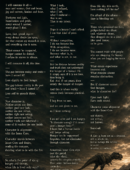
Those bitter moments-
injustice, inequality, cruelty aimed straight at my heart-
I want to forget them.
But I must remember them,
again and again,
turning them over in my mind
until I finally understand
why I failed.
I am a philosopher.
It is my job.
This work keeps the wounds warm.
A failed lover.
A hungry man.
A pauper standing alone.
And I keep insulting myself
in my own eyes.
You count your children, your lovers,
at night-
every night-
in the dim, warm light
of love and respect.
Even after hard work, it never came.
Even after pure intent, it never came.
Even after having every right to it, it never came-
that is the poverty I am speaking of.
Why am I even here?
Where have I come from?
Who am I?
And where am I going?
I am not stopping tomorrow from arriving.
While I am thinking,
no one can stop it.
But it never came
on its own.
Those who claimed to be well-wishers
never came to ask how I was.
They came to judge.
They came to blame instead.
I have no ground to stand on-
I do not own it-so I walk
when even the sky offers no shelter.
This is your world.
Keep her-
the one whose name is Frooti.
She is yours too.
If a romantic loves you,
you will feel love.
If a man loves you,
you will quench lust.
But if an artist loves you,
you will become immortal-
that is a philosopher’s word.
Those who master love’s two and a half letters
are called scholars;
those who weep from the heart
wash away all sins.
People who oppress others
are called tyrants-
but I am the one
who commits tyranny upon myself.
I am Ronie Dinosaur.
I walk.


















[…] Ronie Dinosaur Chapter 114 — This Is My Curse […]