 ABOUT THE POEM:
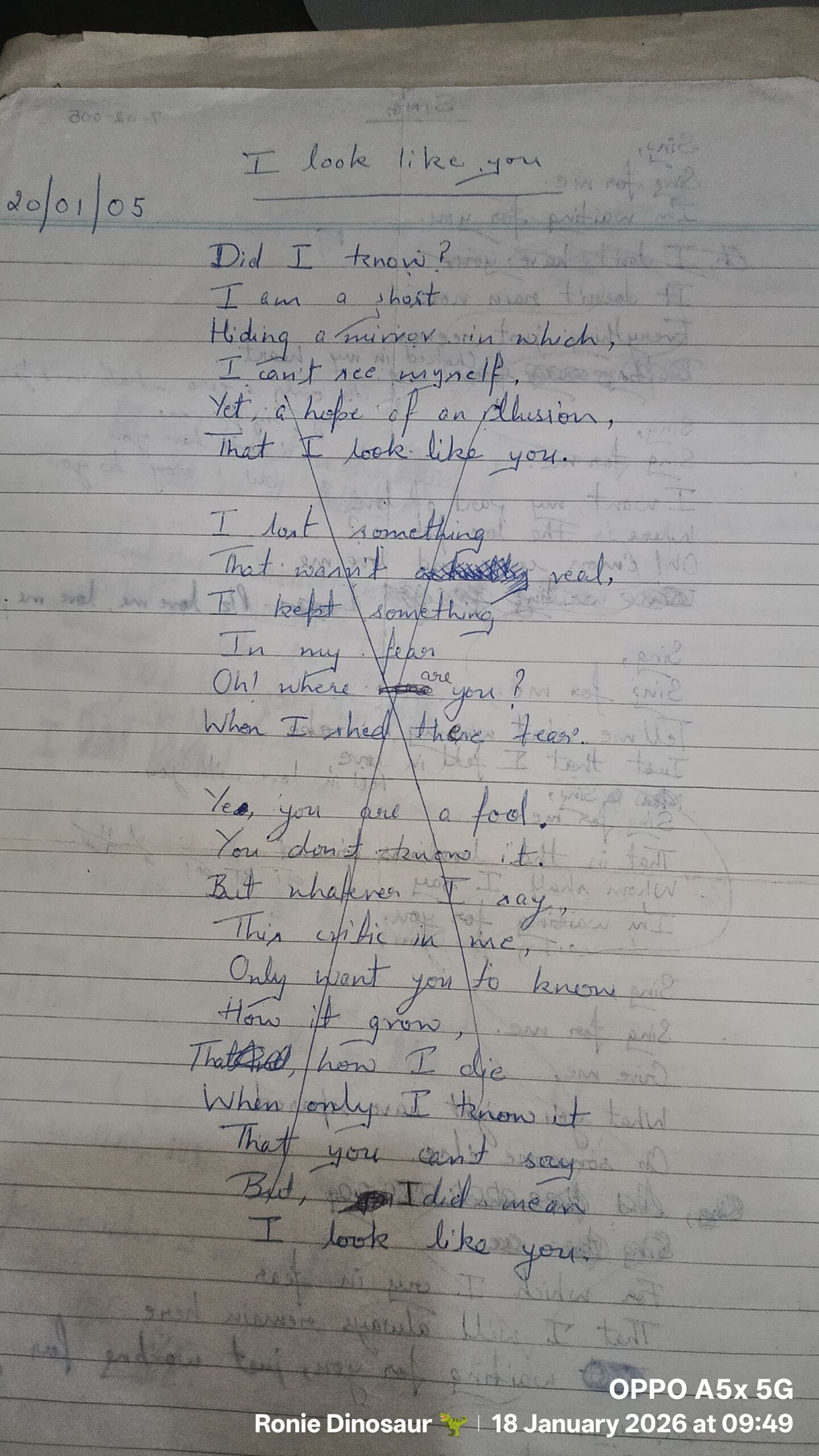
 I Look Like You was written on 20 January 2005, when Ronie was twenty years old. It came after the long collapse that followed his first decisive loss-the rejection that began at fifteen, hardened through seventeen, and finally stripped him of hope altogether. This poem marks a quiet but irreversible psychological shift: the moment when the word “hope” was not merely abandoned on paper, but consciously removed from his inner vocabulary. By this time, “Frooti” was already gone. Not absent in the romantic sense-gone in the structural sense. The poems before this one still reach outward: pleading, questioning, bargaining, asking to be seen. I Look Like You does none of that. It is written from a place where the self has already fragmented and is observing its own damage without expectation of repair. The poem speaks in mirrors, ghosts, and doubles because Ronie no longer experiences identity as whole. “I am a ghost / hiding a mirror” is not metaphor for sadness; it is an accurate description of dissociation. He cannot see himself directly anymore. He only imagines himself through resemblance-I look like you-as if the self survives only as a distorted reflection of the person who caused its fracture. This is also the last text in which Ronie allows the concept of hope to exist at all, even as an illusion. After this, hope is not denied-it is deleted. The decision was not philosophical; it was practical. Hope had proven unreliable, dangerous, and humiliating. Removing it became a form of psychological self-defense. Eighteen months later, reality tested that decision. She returned unexpectedly. Ronie was standing at a bus stop, near a local cold-drink vendor-a transient, ordinary place, not charged with memory or anticipation. She recognized him and shouted, publicly, “Why don’t you talk to me?” The question assumed continuity, shared history, unresolved intimacy. Ronie’s reaction was not anger or bitterness. It was confusion. Is she talking to me? Did we ever talk before? This was not an act. It was genuine non-recognition. By the time she returned, the person who had written those earlier poems no longer existed in the same psychological form. The attachment had not been suppressed; it had decayed. The self had reorganized around absence so completely that her voice no longer triggered memory, only noise. That moment retroactively validates the poem. I Look Like You is not about wanting to become someone else. It is about the fear that identity has already been overwritten by loss-and the strange calm that follows when that fear turns out to be true. The later encounter proves that the poem was not exaggeration, fantasy, or adolescent drama. It was diagnosis. The yellowing pages on which this poem was written still exist. They have aged physically, just as degrees, certificates, and credentials from the same era have aged in value. But the poem has not lost relevance. It has become record. What was written at twenty predicted the silence at twenty-two. And that silence held. This is not nostalgia. This is evidence. I don't hope, pray or dream. Just as Hanisha had done when I was fifteen when I was humiliated outside the my classroom, this girl—Frooti—did the same when I was twenty. She came to return what I had once given. But this time, something had changed. When I looked at her, I remembered: this time, I am Ronie. I went to her. She said she had it and wanted to return it. I kept my head down, my eyes fixed from her knees to her shoes. I took the poem. I already knew what it was—from the ink that had leaked through the back of the paper. Then I turned and walked away.
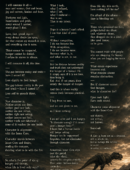
I Look Like You — 20 Jan 2005
Did I know?
I am a ghost,
hiding a mirror in which
I can’t see myself.
Yet there is hope-an illusion:
that I look like you.
I lost something
that wasn’t real.
I kept something
inside my fear.
Oh, where are you
when I shed these tears?
Yes, you are a fool.
You don’t know it.
But whatever I say,
this critic in me
only wants to know
how to grow-
how I die
when only I know it.
You can’t say it,
but I did mean it:
I look like you.