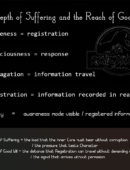





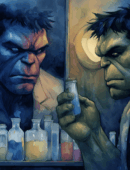

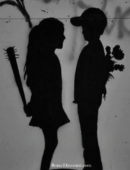


 ABOUT THE POEM: The "Ronie Dinosaur Manifesto" is a visceral exploration of the human condition when stripped of all social scaffolding. At its core, it is a rejection of the "just-world hypothesis"-the comforting but often false belief that good things happen to good people. Ronie, the narrator, has lived a life of extreme emotional duality, oscillating between the "Himalayas" of success and the "Mariana Trench" of despair. Having reached the age of forty-two, he finds himself in a state of "absolute solitude," a condition born not just from bad luck, but from the brutal realization that character, intent, and hard work do not guarantee love or companionship. The narrative arc follows a man who has played by the rules of "hero stories" only to find the rewards missing. He describes a series of domino-like losses-money, status, and most poignantly, a love that was given but never returned. This led to a period of collapse and a subsequent stint in rehab. His "return" is marked by a stark, cold clarity: he is the only one left to do the work of living. He has traded the "luxury of excuses" for the "iron discipline" of hygiene, work, and sobriety. Yet, this discipline is a lonely victory. It provides stability but not warmth. One of the most powerful metaphors in the text is the "four left turns." By walking in a perfect square, Ronie returns to his own door without having encountered a single soul. This illustrates the "emptiness of the world"-a psychological state where social connections have withered to the point of invisibility. He lists the absences in his life with rhythmic precision: no bride, no child, no mother, no brother, no God. He is a man who has achieved "iron character" but has no one to witness it. The manifesto concludes with a profound psychological paradox. While Ronie expects nothing from a world that has "rigged the game," he still acknowledges an inherent human need for a "living witness." He does not ask for salvation or a romanticized rescue; he asks for the simple, fundamental recognition of his existence. He seeks someone to say, "I see you." This is the "Dinosaur’s" dilemma: being strong enough to survive alone, yet human enough to know that survival is not the same as living. By naming himself "Ronie Dinosaur," he identifies as a relic of a different era-perhaps one where logic and character meant more-but he continues to walk, refusing to be defeated even as he refuses to hope. It is a testament to the "walk" itself, the act of moving forward when there is no destination and no one waiting at the finish line.
The Ronie Dinosaur Manifesto: I See You
It has been a monotonously vast and monstrously cruel life.
Age is a shallow ruler; it cannot gauge the true depth of a soul, nor the savage amplitude of its emotional tides. I have lived at the summit of the Himalayas and in the crushing black of the Mariana Trench.
Life itself was my tutor, teaching me the brutal price of being in the wrong place at the wrong moment. I learned the cold gulf between power, money, and status-and the fragility of innocence. I learned that golden intent can still yield only lead. Character does not guarantee reward. And my love-a clean vessel-poured itself out and received nothing in return.
To hell with it all. I got nothing back.
She took mine and never returned it.
Humans do not treat humans as human. Cleverness and worldly cunning routinely trample quiet, simple truth. Life forced me to become a philosopher. The game was rigged from the beginning to break a heart and a mind that dared to seek logic when character could no longer shield them from insult.
One loss toppled the next.
The first domino crushed the second, then the third, until I stood in ruins-not from my own errors, but from choices made by a naïve heart and an inexperienced mind.
Returned from rehab, I am now so lonely that I interrogate my own shadow. I tell myself: if I had been right, this would not feel so wrong. I struggled, fell, and sank into depression’s grey. I woke only when I realized that neither people nor life were coming to help. I am the only one left to do the work, and I must do it without excuses.
I discovered a terrible truth: life does not reward brave hearts. Courage is a useless shield against the raw weight of bad luck. Do not laugh too loudly at my misfortune. I want nothing from you-nor did I ever. I only wanted to live, and now I only wish to pass my remaining time. Yet the solitude is absolute.
I try to summon what once worked: jogging, hygiene, discipline, hard work for a living, facing failure without fear-doing it all with style, sobriety, and iron emotional stability. Discipline, unlike love or luck, actually answers when called.
I have fallen four times, and I have stood up three.
I am now at a stage where I want to find people, but the world has emptied out. I leave my house and take a left turn, then another. I find no one. I take a third left-still no one. With the final left, I return to my own door. I see no one.
Once, discipline gave me strength, a thousand friends, and millions in currency. I had time then. Now time is short, and there is no one left on the road.
No beast, no companion.
No bride to hold, no child to carry.
No mother’s grace, no sister’s warmth, no brother’s strength.
Not a single soul I can call a friend.
No lover to claim, no vice to chase, no ghost in the sheets.
No God to serve, no father to fear.
No hearth to call home.
None to lead me, none to follow.
No heaven above, no ground beneath.
This is the absolute scale of my solitude.
After all the abilities gained, prior achievements, iron character, and a heart full of love, I have still nothing at all. Intent, character, and hard work do not function the way hero stories promise.
All I can do is walk. And so I walk.
This man is not yet defeated, and the world has not yet won. I have nothing left to lose. Since I no longer beg, hope, pray, or dream, I expect nothing from anyone.
That is the irony-the dilemma: how, then, does the journey grow?
I need someone to give me love.
I am searching for beauty, for truth-whether it exists in this world, I no longer know.
But I cannot love alone.
For that, I need another human being.
And I do not have that someone.
I need contact-not salvation, not romantic mythology, but a living witness who can say:
I see you.
My character won’t permit me to lose,
And you might win; that I won’t let you choose.
This is me.
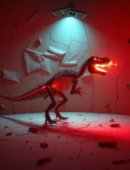
I am Ronie Dinosaur.
I walk.