 ABOUT THE POEM:
 Chapter 101 - COST functions as a documentary endpoint rather than a narrative resolution. It does not summarize the preceding chapters; it verifies them. The chapter is structured around two dated psychological states-2005 and 2026-treated not as memories but as observable data points. The text insists on chronology because time is not symbolic here; it is causal. What happens in 2005 determines what becomes necessary in the years that follow. The chapter introduces the mirror not as a metaphor for introspection, but as a psychological mechanism. In 2005, the mirror fails. The speaker describes dissociation accurately: the self cannot be accessed directly and survives only through resemblance to another person. Identity is externalized, unstable, and dependent. This is not emotional sadness but functional fracture. The line “I look like you” is not romantic longing; it is evidence of identity displacement following attachment injury. The 2026 section documents adaptation rather than healing. The speaker does not claim recovery, closure, or growth. Instead, he describes a compensatory strategy: simulated intimacy through internal images. The body and behavior remain capable of closeness, but connection is mediated by reflection rather than encounter. The mirror now returns something-but only because the speaker places it there himself. This is survival through internal substitution, not repair. The chapter repeatedly rejects aesthetic distance. It states plainly that the words themselves are the cost, not a record of it. Writing is not presented as therapy or catharsis; it is an expenditure. The poem treats language as residue-what remains after endurance-not as transformation. This positions the text closer to a psychological case file than to confessional lyric poetry. The mirror’s evolution is central. It is explicitly stated that the mirrors are not duplicates. They are the same internal mechanism repurposed under pressure. In early dissociation, the mirror enables disappearance. Later, it enables alignment-standing upright without hope, cure, or expectation of repair. The shift is functional, not philosophical. The reference to consciousness leaving the body operates psychologically rather than mythologically. It describes a condition where behavior continues after subjective experience withdraws. Grief is defined not as emotion but as structural absence. Even without external knowledge of myth, the reader is given sufficient information to understand the mechanism: consciousness departs before the organism fails. The closing sections refuse diagnosis, consolation, or moral framing. The speaker identifies himself as both subject and observer, patient and author. Self-knowledge emerges not through healing but through refusal-refusal to accept imposed narratives, sentimental explanations, or false hope. The final inventory-what was taken, refused, and endured-serves as an ethical accounting rather than a conclusion.
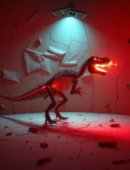
Ronie Dinosaur Chapter 101 – COST
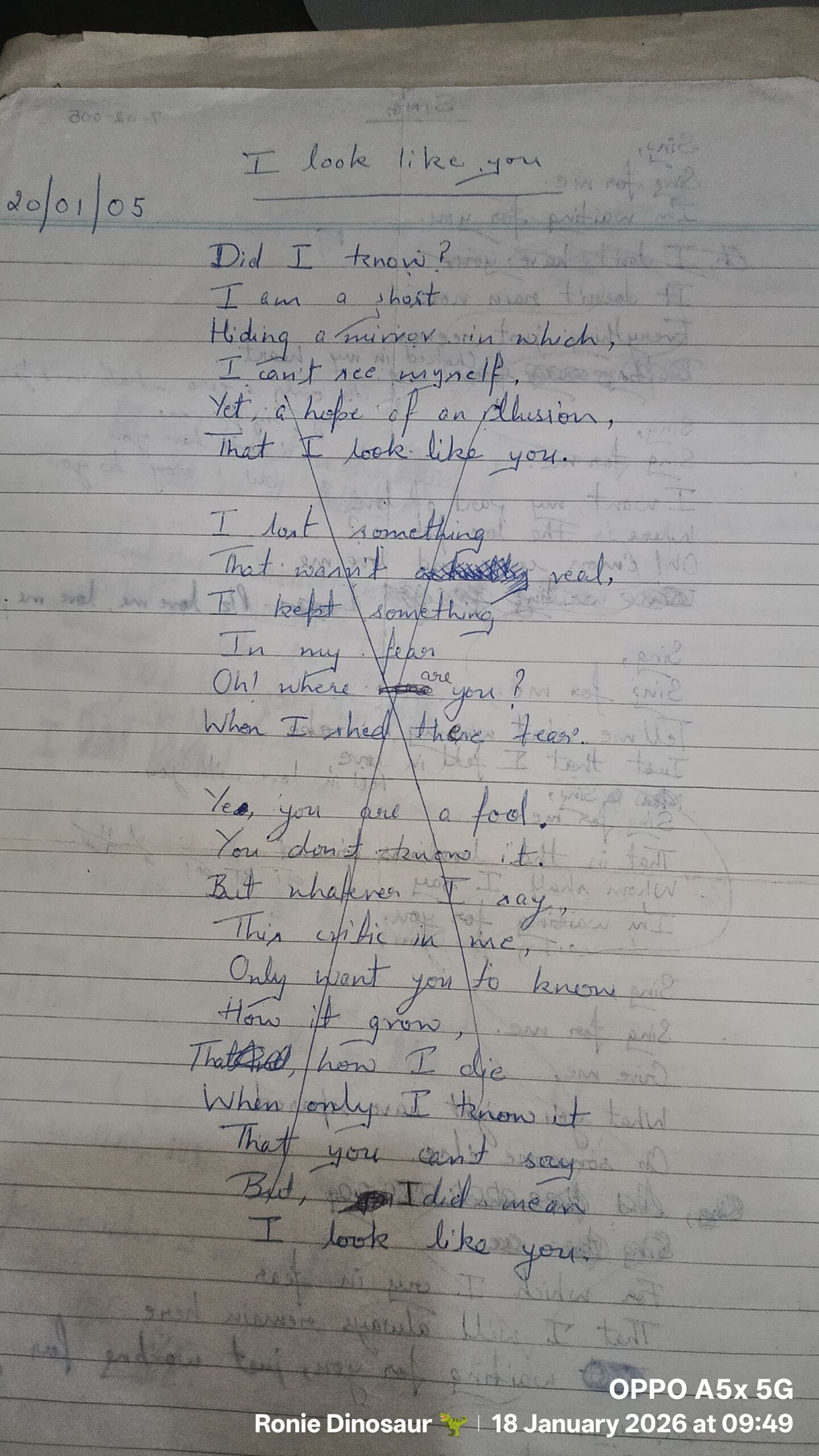
In 2005, when she left,
this is what I became-
I am a ghost
hiding a mirror in which
I can’t see myself.
I look like you.
In 2026, I am still writing-
this is what surviving as that thing has cost-
He has been close: arms spread wide,
reaching, gathering, hugging, placing an image
against the mirror inside him,
cuddling the reality and feeling the satisfaction
of cuddling the reflection inside.
These words do not record the cost.
They are the cost.
The mirrors were never duplicates.
They were stages of one instrument
forced to evolve under pressure.
The first mirror proved the break.
The later mirror proves the price
of continuing without repair.
Together,
they are not memory.
They are evidence.
Twenty years separate the texts.
The same psychological hardware,
same mechanism,
different function,
rewired by time,
without hope or cure.
Once, the mirror was used to disappear-
dissociation as shelter.
Now it is used to stand straight-
alignment without comfort.
Yes and no:
the mirror is the same.
Its purpose is not.
Consciousness once fled the body-
as when Sati died
and Shiva learned what grief names.
This reads like a case study
written by the patient
who refused diagnosis.
That refusal
is how I learned
who I am.
What I took,
what I refused,
what I endured.
That is the residue,
resurfacing as truth.