 ABOUT THE POEM:
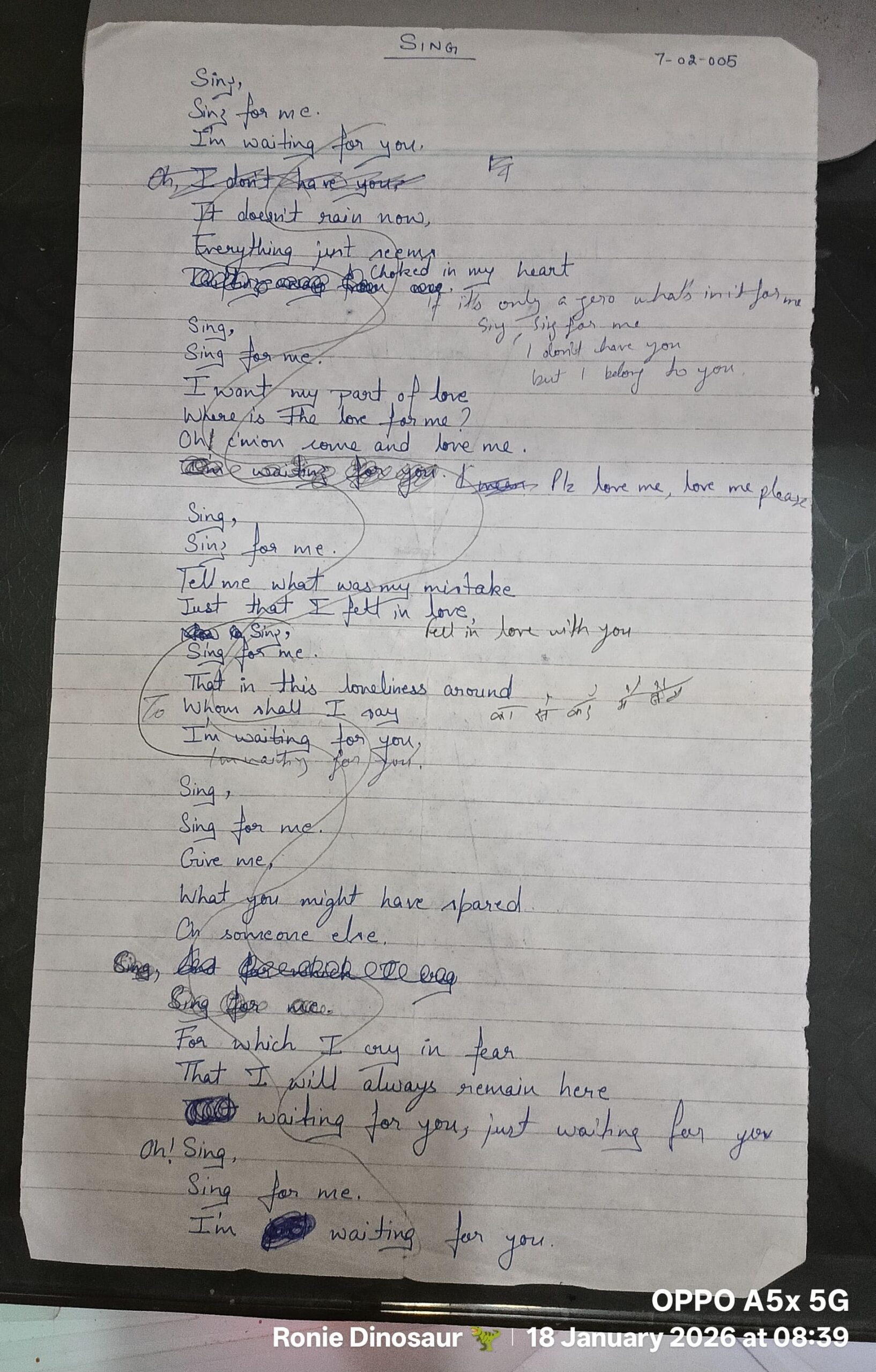
 “Sing - 07 Feb 2005” was written by Ronie in his early twenties, during college, at a moment when emotion outran certainty and language became a holding pattern. The poem presents itself as a song because that was the most honest container available then: chorus, repetition, insistence, return. It is not persuasion; it is waiting put into rhythm. The speaker asks to be sung to because he cannot yet speak himself into resolution. The physical page matters. The paper on which this song was written has turned yellow with time, and the entire poem was crossed out immediately after it was completed. That act is not erasure; it is annotation by refusal. The crossing-out functions as a private injunction, written on the same page, to prevent a mistake from becoming an action. The note-“this is not meant to be done this way… don’t send it, don’t write it”-records the moment restraint begins to exist alongside desire. The page holds both the urge and the boundary, equal in ink. The addressee, named privately, is not present in the poem as a character but as an absence that structures every line. The speaker does not claim entitlement; he asks for what might have been “spared on someone else,” a phrasing that acknowledges asymmetry without disguising pain. The repetition of “I am waiting for you” is not hope masquerading as confidence; it is time stalled. This is the voice of someone who has not yet learned how to move forward without permission. The setting-college years, ordinary days, common spaces-contrasts with the intensity of the interior. Nothing dramatic happens in the world of the poem. There is no storm; “it doesn’t rain now.” The choking occurs inside the chest. That restraint in imagery is deliberate and period-accurate. It reflects a young writer choosing directness over metaphor because metaphor felt dishonest at that moment. What makes the piece endure is the decision not to send it. The poem becomes a document of self-governance rather than a bid for response. The yellowed page, crossed lines, and prohibitive note transform a love song into an artifact of learning. The reader is allowed to witness the instant when expression stops short of intrusion. Read now, the song is less about the person addressed and more about the formation of a boundary. It captures a precise emotional weather from 2005, preserved without revisionism. The grammar is simple because the feeling was simple and heavy. The value of the piece lies not in polish but in preservation: a record of how longing sounded before it learned to be quiet, and how restraint first learned to speak.
Sing — 07 Feb 2005
Sing,
sing for me,
I am waiting for you.
Oh, it doesn’t rain now;
everything just seems
choked in my heart.
If it’s only a zero,
what’s in it for me?
Sing,
sing for me,
I don’t have you,
but I belong to you.
Sing,
sing for me,
I want my part of love.
Where is the love for me?
Oh, come on-come and love me.
Please love me, love me, please.
Sing,
sing for me,
tell me what my mistake was-
just that I fell in love,
fell in love with you.
Sing,
sing for me,
that in this loneliness around me,
to whom shall I say,
“I am waiting for you,
I am waiting for you”?
Sing,
sing for me,
give me
what you might have spared
for someone else.
For which I cry in fear
that I will always remain here,
waiting for you,
just waiting for you.
Oh, sing,
sing for me,
I am waiting for you-
just for you.
(On the yellow paper, all of this is crossed out.)
(I crossed the whole song after writing it,)
(to remind myself: this is not meant to be done this way.)
(She is not going to understand you anyway.)
(So don’t send it. Don’t write it.)
(When I asked her to be my girlfriend, she said no.)
(I told her, “Don’t talk to me now.”)
(After fifteen days, she came back.)
(She returned a song-a poem I had given her eight months earlier.)
(She said, “I had it.”)
(Every damn thing which I am telling in First-Order truth is not a fantasy or imagination, it has weight, the weight of lived reality.)
(Here’s one proof.)